EDITORIAL/DISCUSSION
Reimagining Virtual Nursing: The Role of AI
Melody Cibock, MSN, RN1 ; and Victoria L. Tiase, PhD, RN, NI-BC2
1Sutter Health, Sacramento, California, USA; 2Department of Biomedical Informatics, University of Utah, Salt Lake City, Utah, USA
Keywords: artificial intelligence, nursing, patient portal, telehealth, triage, virtual nursing care
Citation: Telehealth and Medicine Today © 2024, 9: 529.
DOI: https://doi.org/10.30953/thmt.v9.529
Copyright: © 2024 The Authors. This is an open-access article distributed in accordance with the Creative Commons Attribution Non-Commercial (CC BY-NC 4.0) license, which permits others to distribute, adapt, enhance this work non-commercially, and license their derivative works on different terms, provided the original work is properly cited and its use is non-commercial. See http://creativecommons.org/licenses/by-nc/4.0.
Received: September 30, 2024; Accepted: November 8, 2024; Published: December 16, 2024
Funding Statement: None.
Conflicts of Interest: Victoria L. Tiase, PhD, RN, is a member of the editorial board of npj Health Systems.
Corresponding Author: Dr Victoria L. Tiase, Email: victoria.tiase@utah.edu
During the COVID-19 pandemic, there was a surge in demand for telehealth services as patients sought to avoid in-person visits to healthcare facilities. Patients began to experience and expect medical services without geographic constraint. As telehealth modalities expanded, additional benefits were realized. For example, telehealth can be less expensive than in-person care, eliminating the need for office space, equipment, and other overhead costs associated with the traditional delivery of healthcare.1
In addition, telehealth can contribute to improving patient outcomes by providing timely access to care and increasing patient adherence to treatment plans.1 Enhancing communication between care teams can lead to better care coordination.2 Telehealth creates efficiencies for providers by reducing time spent on administrative tasks and providing flexibility in terms of the location or setting where providers can see patients.3 These benefits, along with the advent of an array of telehealth platforms and technical capabilities, enable team-based care models that involve virtual nursing care. Combining virtual care models with artificial intelligence (AI) offers the potential to be transformative to nursing practice.
The move to digitally enabled care has been rapid; however, with the proliferation of AI—specifically generative AI—there is an opportunity to scale virtual nursing exponentially. AI is formally defined as “the study and design of intelligent agents,” or computer systems that perceive their environment in some manner and respond with actions that maximize their chance of success—activities generally associated with intelligent beings.4 In healthcare, AI refers to various technologies and tools with the potential to improve patient experience and efficiency.5 AI can transform the workload of clinicians by augmenting up to 40% of the healthcare workflow.6
Virtual Nursing
At a time when there is a shortage of nurses willing to work under the current conditions, the use of AI alongside virtual nursing care models allows for flexibility and efficiency and potentially reduces the cognitive load associated with documentation burden.6 One example of this care model is the team-based workflow for remote triage and advice—a type of virtual nursing. Virtual nurse triage and advice is characterized by patients requesting asynchronous advice by entering a message in the patient portal issued by their provider or healthcare organization. To augment the care process, AI can be inserted into the virtual nursing workflows to decrease response time.7 AI can be used to draft responses to patient messages using empathetic language, suggest a diagnosis, and recommend a level of care.
Piloting AI-powered Tools With Virtual Care
One integrated healthcare delivery system is piloting AI-powered tools with virtual care workflows to help nurses reduce cognitive load and decrease response time to patient messages. The initial pilot includes over 1,000 nurses practicing in family medicine, internal medicine, and pediatrics, associated with 200 outpatient clinics across northern California. The AI tool uses a large language model to analyze structured and unstructured data within the electronic medical record to generate text responses that nurses can use to draft a response to the patient in a welcoming, human-like tone (Figure 1).
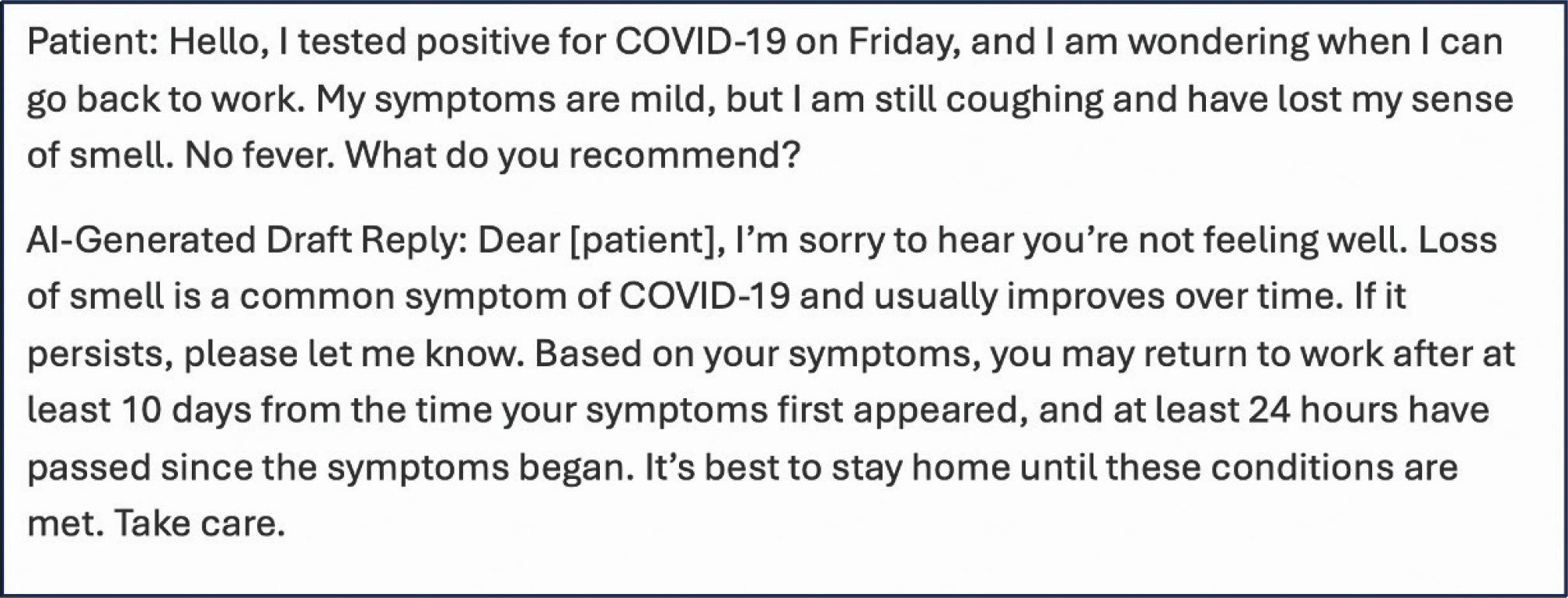
Fig. 1. Example of an AI-generated message exchange. AI: artificial intelligence.
The nursing workflow consists of the following components: First, the nurse reviews the AI-generated draft and determines whether a clinical assessment of the patient is needed. If not, the nurse may edit the response to include additional nursing recommendations. Next, the message may be personalized further to enhance relationship-centered care. Because nursing notes are typically free text, using AI can save on average 15 minutes per encounter. The patient receives a more rapid, personalized response, which permits the nurse to spend time focusing on other important tasks. This use case demonstrates how AI can help nurses work more efficiently to recommend a personalized and actionable response.
While the adoption of this technology is nascent, current successes present an opportunity to scale to over 15,000 nurses. Initial pilot survey results indicate that over 90% want to continue using AI technology, and almost 75% of the nurses believe that it reduces cognitive effort. In addition, the virtual model allows nurses to be physically located anywhere, as long as they are licensed to practice in that area, while being employed by the health system.
As health systems consider accelerating the incorporation of AI into virtual nursing care models, the following points should be considered:
AI Combined with Virtual Nursing
The AI/virtual nursing combination presents the opportunity to reexamine professional scope, delegation protocols, and interprofessional collaboration.
Many organizations are scrambling to provide guidance on what is in and outside the scope for each professional level, since regardless of the AI-drafted response, clinicians cannot send a message outside their professional scope. This requires organizations to establish clear boundaries for the level and type of care that is appropriate for each nurse’s level of training—considering that nurses spend a lot of time on work that could be AI-automated or done by other care team members.
Given that these boundaries can be difficult to define, there should also be a focus on clear systematic supervision protocols through which patients are virtually connected to more experienced clinicians throughout care processes as needed. In addition, it is important to connect the use of AI to patient safety and quality standards by establishing “guardrails” and setting clear expectations for patients and providers. As policies and procedures are developed, interprofessional collaboration is a necessity to ensure that all disciplines are represented during the early stages of planning and designing AI-enabled virtual nursing workflows.
Integrating AI into Clinical Processes
Introducing AI into clinical processes can be a transformational change for an organization. Change management—implementing an approach to organizational change—is critical for success and, in the case of AI, paramount for patient safety. When not implemented properly, there might be a lack of transparency on how AI results are generated.
Employing change frameworks such as ADKAR (awareness, desire, knowledge, ability, and reinforcement) and incorporating principles of implementation science are key. Specifically, there should be a progressive rollout of virtual nursing and AI. This includes demonstrating a level of safety by testing with humans, then testing without humans, and finally deployment. To ensure successful adoption of AI technologies, leaders can also set expectations and facilitate dialogue to encourage buy-in. In addition, ongoing collaboration between data scientists and nurses should be emphasized so that all stakeholders trust, understand, and use AI.
The AI–Human Partnership
In healthcare, the AI–human partnership is a powerful alliance. Rather than viewing AI as a replacement for nursing expertise, AI should be viewed as a tool to enrich the quality of the care experience. However, it can be a challenge to strike the right balance. Balance can be achieved by using AI to eliminate non-nursing tasks, such as administrative tasks, to preserve the therapeutic nursing relationship and by emphasizing a patient-centric AI design.
Nurses are in the best position to educate patients about the benefits and risks of AI, including what it does and does not do. All practicing nurses should receive training on AI (e.g., data science principles) to provide talking points to patients and use AI to augment critical thinking and provide compassionate care. Given the fast-moving regulatory efforts in the AI space, nurses must be a part of conversations on the possibilities and limitations of AI in the context of local and state policies.
Contribution of Nurses to Design and Development
Nurses comprise the largest percentage of the workforce in most healthcare organizations, with valuable perspectives on designing systems for patient safety and quality.8 Nurses should be provided with opportunities to influence the design and development of virtual nursing and AI programs. Examples include championing a practice change, leading a pilot in their respective departments, evaluating the usability of virtual technology, and helping to define and measure the outcomes of an AI tool.
In the absence of nursing involvement, valuable perspectives on bias, liability, privacy, and patient safety might be lost. Table 1 presents tips for nurses who want to get started in AI.
Final Thoughts
Telehealth continues to expand access to care. It is a valuable tool to connect patients with nurses. AI can be used to augment virtual nursing processes, allowing for scalability and efficiency. The nursing profession is poised to leverage the power of AI in novel care models and accelerate virtual innovations that support a robust nursing workforce.
Contributors
Both authors contributed equally to this publication.
Data Availability Statement (DAS), Data Sharing, Reproducibility, and Data Repositories
No datasets were used in this.
Application of AI-Generated Text or Related Technology
AI-generated text or related technology was not used in this.
Acknowledgments
The authors thank all registered nurses, especially those who champion virtual nursing efforts.
References
- Gajarawala SN, Pelkowski JN. Telehealth benefits and barriers. J Nurse Pract. 2021;17(2):218–21. https://doi.org/10.1016/j.nurpra.2020.09.013
- DeBlois D, Millefoglie M. Telehealth: enhancing collaboration, improving care coordination. Nurs Manage. 2015;46(6):10–12. https://doi.org/10.1097/01.NUMA.0000465402.45956.99
- Hirko KA, Kerver JM, Ford S, Szafranski C, Beckett J, Kitchen C, et al. Telehealth in response to the COVID-19 pandemic: implications for rural health disparities. J Am Med Inform Assoc. 2020;27(11):1816–18. https://doi.org/10.1093/jamia/ocaa156
- Russell SJ, Norvig P. Artificial intelligence: a modern approach. Pearson, London; 2016.
- Burton RJ, Albur M, Eberl M, Cuff SM. Using artificial intelligence to reduce diagnostic workload without compromising detection of urinary tract infections. BMC Med Inform Decis Mak. 2019;19:1. https://doi.org/10.1186/s12911-019-0878-9
- Glaser J. Understanding artificial intelligence in healthcare [Internet]. American Hospital Association; 2018 [cited 2024 Sept 20]. Available from: https://www.aha.org/news/insights-and-analysis/2018-01-23-understanding-artificial-intelligence-health-care
- Ball J. Virtual nursing what is it? [Internet]. American Nurses Association Innovation; 2024 [cited 2024 Sept 13]. Available from: https://www.nursingworld.org/practice-policy/innovation/blog/virtual-nursing-what-is-it/
- Al Yahyaei A, Hewison A, Efstathiou N, Carrick-Sen D. Nurses’ intention to stay in the work environment in acute healthcare: a systematic review. J Res Nurs. 2022;27(4):374–97. https://doi.org/10.1177/17449871221080731
Copyright Ownership: This is an open-access article distributed in accordance with the Creative Commons Attribution Non-Commercial (CC BY-NC 4.0) license, which permits others to distribute, adapt, enhance this work non-commercially, and license their derivative works on different terms, provided the original work is properly cited and its use is non-commercial. See http://creativecommons.org/licenses/by-nc/4.0.