NARRATIVE/SYSTEMATIC REVIEWS/META-ANALYSIS
The Impact of a Continuum of Care on Health Outcomes: An IEEE Perspective
Elizabeth White Baker, PhD1  ; Katherine Grace (Kit) August, PhD2 ; Narendra Mangra3 ; Dimitrios Kalogeropoulos4 ; Andres Mellik, MSc/Meng5 ; Paula Muller, PhD6 ; Thomas M Willis, III, PhD7 ; Raziq Yaqub, PhD8 ; Victor B. Lawrence9 ; Mathini Sellathurai, PhD10 and Michael Tremblay11
1Virginia Commonwealth University, Richmond, VA, USA; 2IEEE Senior Member; 3GlobeNet LLC, New Orleans, LA, USA; 4Global Health & Digital Innovation Foundation, UCL Global Business School for Health, London, England; 5Cognuse Inc. EdTech, Tallin, Estonia; 6CareLink360, Flemington, NJ, USA; 7AT&T Labs, Atlanta, GA, USA; 8Alabama A&M Graduate School; 9Stevens Institute of Technology, Hoboken, NJ, USA; 10Heriot-Watt University, Edinburgh, Scotland; 11University of Kent, Canterbury, UK
Keywords: AI in healthcare, digital health, global health, health equity, health technology, healthcare access, remote monitoring, sustainable development, telemedicine
Note: An addendum, defining terms, appears at the end of this article.
Abstract
In this article, the authors explore the transformative potential of digital health technologies to advance a continuum of care (CoC) model aimed at improving health outcomes and reducing disparities. Drawing on an Institute of Electrical and Electronics Engineers (IEEE) perspective, it highlights how standards-based innovations—such as artificial intelligence (AI)-driven telemedicine, Internet of things (IoT)-enabled remote monitoring, and mobile health—can deliver personalized, timely, and accessible care across diverse populations. Through real-world examples, including mobile clinics and population health platforms, the article illustrates successful implementations that address health inequities. In addition, the authors discuss the technical, economic, and governance challenges that clinicians face in integrating these solutions into routine care. Central to this work is the role of IEEE standards in ensuring equitable access, data interoperability, and built-in accessibility for all users. The paper advocates for a transdisciplinary and inclusive approach, empowering clinicians and technologists to collaborate in creating patient-centered systems that span the entire care journey—from prevention to treatment to recovery—regardless of setting or socioeconomic status.
Plain Language Summary
Healthcare today is more advanced than ever, but many people still struggle to access the care they need—especially those in underserved or rural communities, people with disabilities, and older adults. This article explores how technology can help close these gaps and make healthcare more accessible, affordable, and effective for everyone.
One promising solution is a “continuum of care” (CoC), which means providing care that is connected, coordinated, and continuous across all stages of a person’s health journey. This includes everything from prevention and diagnosis to treatment, recovery, and long-term support. New digital tools like telemedicine, wearable health monitors, and artificial intelligence (AI) are helping doctors and nurses care for patients in real time—even when they are at home.
Also highlighted is the role of the IEEE, a global standards organization, in making sure this technology is safe, reliable, and inclusive. Their work supports tools such as mobile hearing tests, health data sharing systems, and AI that helps doctors make better decisions. These technologies are especially useful in areas with limited healthcare resources.
The authors share real-life examples, such as mobile clinics and virtual care programs, that are already improving care for people with chronic illnesses or living far from hospitals. Still, challenges remain, including ensuring that these technologies are easy to use and protect patient privacy.
Ultimately, the authors call for collaboration between healthcare workers, engineers, and communities to build a future where healthcare is connected, compassionate, and available to all—regardless of who they are or where they live.
Citation: Telehealth and Medicine Today © 2025, 10: 557
DOI: https://doi.org/10.30953/thmt.v10.557
Copyright: © 2025 The Authors. This is an open-access article distributed in accordance with the Creative Commons Attribution Non-Commercial (CC BY-NC 4.0) license, which permits others to distribute, adapt, enhance this work non-commercially, and license their derivative works on different terms, provided the original work is properly cited and the use is non-commercial. See: http://creativecommons.org/licenses/by-nc/4.0. Please note: The authors of this article own the copyright.
Received: February 4, 2025; Accepted: April 23, 2025; Published: May 30, 2025
Funding Statement: No external funds were used to support this research.
Financial and non-Financial Relationships and Activities: No relevant disclosures.
Corresponding Author: Elizabeth White Baker, Email: bakerew@vcu.edu
Significant progress has been made in various aspects of the healthcare domain, including, but not limited to, research and technology contributions. Yet, the overall outcomes reflect a fragmented system with significant disparities among different groups. There is an opportunity to more effectively meet the needs of all constituents and stakeholders across the spectrum of patients and providers, engaging everyone with culturally and linguistically appropriate systems, simplifying processes, providing transparency, and delivering data and information needed in each interaction promptly with emerging and new models of care. Technology-enhanced healthcare can result in extending life, reducing suffering, reducing risk, and improving the experience for everyone, positively impacting the individual, family, community, and society locally and globally. Technology can be employed to identify new uses of existing medications and to recognize interactions elevating risk for individuals, potentially reducing adverse drug and device events. Today, language technology is sophisticated enough to improve communication and transparency in the healthcare experience, identify trends, and determine quality.
However, there is much to do to establish these potential benefits of technology more deeply into the patient community. Even the most impressive algorithms to detect sepsis, for example, will not be effective in improving health outcomes to overcome societal barriers if the care process has built-in delays, such as delays entering data into a system, staff being unavailable, or delays in providing interventions.
Ieee Standards Within the Continuum of Care
The Institute of Electrical and Electronics Engineers (IEEE) standards are leading the way to ensure sustainability and resilience through inclusion and accessibility that will improve transparency and be designed and built in from the start—not just as an afterthought. Testing can also be constructed to calibrate hearing, vision, dexterity, cognitive abilities, reading comprehension, subject matter skills, language preferences, independence, mobility, prosthetics/orthotics, and more. IEEE standards will guide these features to create a positive experience across the healthcare community.
Reliability and sustainability for the future rely on innovations to bridge the digital divide and embrace diversity, equity, inclusion, and accessibility. Projects undertaken by the IEEE are creating standards around technology for people with various needs, including disabilities related to hearing, vision, mobility, agility, cognitive, mental, emotional, and aging, that require assistance at different points in life or in various contexts. Built-in accessibility ensures reaching more people, especially because many do not identify as disabled. Many people do not realize accessibility features can help them or others. Some accessibility features include screen readers for the blind, hearing assistance, speech understanding, captioning, relay communications, navigation, mobility assistance, situation awareness, and emotional, cognitive, and intersectional needs.
Therefore, IEEE standards also infer interface needs from aligning communities of interest (COI), for example, which makes it possible to adapt the interface, offering various features, without relying on a medical diagnosis. The process of meeting technology needs can be simplified by reducing constraints of the medical model, which is the goal of IEEE P3386 Standard for Defining and Inferring User Accessibility Needs for Applications including Augmented Reality and Artificial Intelligence Systems. The IEEE P3337 Standard for Requirements for Designing Accessible Intelligent Cyber-Physical Systems (AICS) for Well-Being addresses these technology needs in cyber-physical systems. These features should be available to everyone without any process or diagnosis, reducing the digital divide for many more people.
Hardware standards for mobile devices with the same capabilities but less expensive than the usual diagnostic and accessibility hardware are essential to bridging economic health inequality while creating technology solutions that meet the needs of a larger percentage of the population. According to the World Health Organization, globally, 1.5 billion people suffer from hearing loss, and 430 million suffer from disabling levels of hearing loss that can be mitigated.
With the emergence of mobile devices, the opportunity exists to meet these challenges. The IEEE P2650 standard for enabling mobile device platforms to be used as pre-screening audiometric systems will establish the performance, interoperability, and validation requirements of a mobile device platform that typically consists of a mobile phone device in conjunction with a portable or wearable device and associated software to be used as an audiometric pre-screening device. This project is particularly vital to emerging economies where diagnostic screenings are out of reach for most populations due to accessibility, affordability, and other roadblocks. The standard will enable use in remote and rural areas and also drive awareness and prevention of secondary issues, such as depression, unemployment, cognitive decline and dementia, and academic underachievement.
Delivering care to patients at any point along the continuum of care (CoC) requires mobile and wearable devices that are being increasingly developed for healthcare purposes. These devices collect a myriad of personal health data consisting of digital biomarkers, which are physiological and behavioral measures collected using digital devices such as portables, wearables, implantables, or digestibles that characterize, influence, or predict health-related outcomes. The IEEE 1752.1™-2021: Standard for Mobile Health Data will provide standard semantics to enable meaningful description, exchange, sharing, and use of such mHealth data. Data and associated metadata complying with this standard will be sufficiently clear and complete to support their use for a broad set of consumer health, biomedical research, and clinical care needs. Standardizing mHealth data and metadata will reduce the costs of using this data for biomedical discovery, improve health and disease management, and make more health interventions more affordable and accessible for a broader population.
Sharing clinical data throughout a patient’s care cycle along the CoC is an essential capability that is difficult to achieve in clinical practice. The P3493.1 standard establishes a framework for Secure, Compliant, Coordinated, and Inclusive Healthcare Data Recycling (SCCI-HDR) for the cancer care use case. The HDR facilitates coordinated sharing of comprehensive clinical data throughout the patient care experience, helping to ensure the development of a cohesive data set reflective of care context and outcomes. It provides context-sensitive information to diverse collaborators, including AI, facilitating the identification of patient-specific care needs to deliver individualized services.
Healthcare clinicians and technologists are forming a powerful coalition to make these cutting-edge solutions more accessible to more patients and improve health outcomes across a broad spectrum of patients and conditions. These standards will further enable delivery of care to the patient when and, most importantly, where it is most efficacious. The most promising approach being advanced is that of the CoC, also referred to globally as continuity of care.1
The Transdisciplinary and Equitable Coc
One approach to addressing these gaps in healthcare outcomes is integrating different functions in the healthcare ecosystem that contribute to healthcare outcomes (technical, social, economic, and governance) into a continuum of objectives. The future CoC can improve the monitoring of conditions in the community that interact with medical conditions and increase the risk of infection and sepsis, for example. Medical interventions can also be a source of risk; for example, recent medical procedures, implanted devices, and their associated risks are known causes of infections. This signals the need to predict the need for precautions for prophylactic antibiotics or elevate alerts of emerging changes in health status, including with body-worn sensor readings. Critical time intervals are shortened with the need for AI algorithms to increase the sensitivity of sensor readings and analysis to detect infection and catch sepsis early in numerous instances. A great many outcomes can be improved by detecting cases of sepsis early and providing intervention immediately. This is incredibly challenging because sepsis can develop over an extended period.
The CoC of the future can also manage the patient-distributed network at home to improve social connections to reduce depression for the hospital at home, formal and informal healthcare, telehealth, monitoring, implanted devices, insulin storage, oxygen generators, custom seating/wheelchairs, air mattresses, lifts, or other durable medical equipment with implications, for example, of electrical power, device charging, security, supplies, communications needs, electromagnetic compatibility risks, and equipment maintenance. However, it is challenging for people to become their own information technology experts. The more hospital at home, telemedicine, home monitoring, and patient-implanted devices are used, the more patients and their informal caregivers will require better information and training for electromagnetic compatibility among the network components to achieve appropriate humidity levels and recognize issues and emergencies. The CoC systems can provide connections, remote monitoring, safety, and security.
Telehealth services that underpin the CoC can be deployed globally through a transdisciplinary framework focusing on healthcare services, including broadband accessibility, and cater to local area capabilities, priorities, and constraints. An example is shown in Figure 1 for Baltimore, Maryland, U.S. Ecosystems such as healthcare, transportation, and public safety may be addressed to address the local community needs in conjunction with local broadband network accessibility. Governance functions can address gaps in healthcare access by engaging local governments and strategic partners for connected healthcare for smart cities and rural development, promoting rural connectivity for unserved/underserved areas, and enabling access to communications services as a gateway for advance.
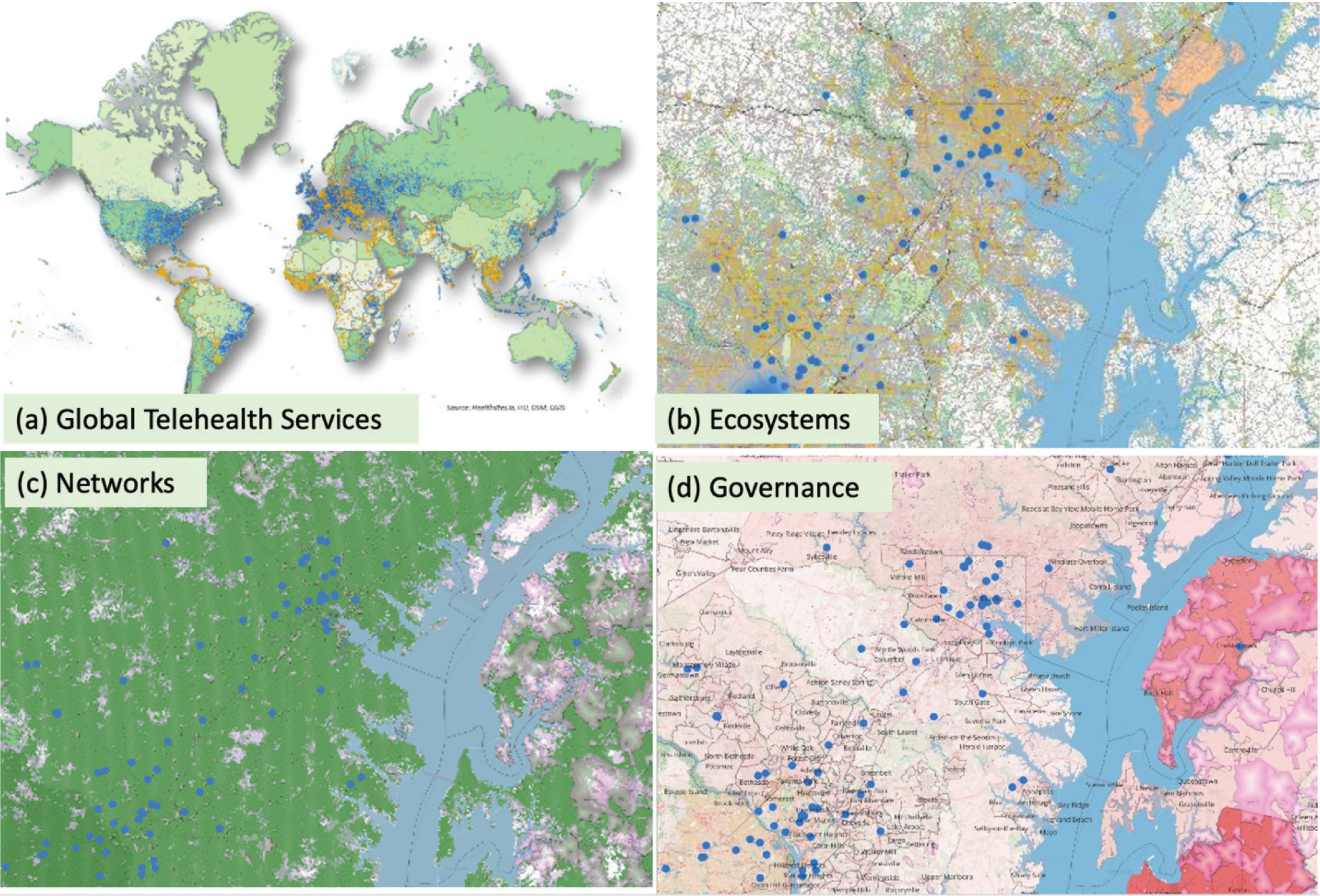
Fig. 1. Transdisciplinary approach example for Baltimore, Maryland, U.S.: (a) global telehealth services, (b) ecosystems including healthcare, (c) broadband network availability, and (d) governance priorities for unserved/underserved areas across multiple jurisdictions. The transdisciplinary framework deployment view may be used to address healthcare access. This approach may be replicated in different areas across the globe for localized solutions.2 Blue dots represent healthcare locations across all maps. The varied colors of the maps set the maps apart from each other and highlight that the maps show different pieces of the CoC over the same geographical area.
We begin by looking in-depth at the transformative potential of digital health technology to implement a technology-enhanced, equitable CoC. Examples of successful telehealth implementations addressing health disparities are presented to demonstrate how these ideas are already being successfully put into clinical practice. The challenges faced in achieving the technical, economic, clinical and governance levels required for a CoC are outlined from the perspective of a healthcare practitioner to provide insight into what barriers must be addressed to make the CoC a reality in clinical practice more broadly. Finally, future research directions that accelerate technology advancements to broaden healthcare reach are discussed, focusing on the IEEE initiatives that support this work.
The Transformative Potential of Digital Health Technologies
Digital health technologies are critical to providing sustainable, equitable, and adequate access to healthcare solutions.3 In the area of trauma medicine, digital health benefits include cost and resource efficiencies from reduced hospital and ICU length of stay and hospital transfers, patient transfer reductions across hospitals, improved equipment and technology for ease of use, quality, adequacy for delivery interventions, and reduced technical difficulties, connection failures, and audio/visual issues, and increased clinician satisfaction through minimal impact to time, assistance with daily practice, enhanced therapeutic relationships, improved delivery of care.4 The following section explores the current state of AI-driven telemedicine, Internet of things (IoT) devices for remote monitoring, and emerging technologies poised to underpin a CoC, such as 5G and edge computing.
AI-Driven Telemedicine: Enhancing Diagnosis, Treatment, and Patient Engagement
AI-driven telemedicine has become an increasingly embedded technology enabler in telemedicine tools, demonstrating efficacy in improving diagnosis accuracy, personalizing treatment plans, and enhancing patient engagement. Each of these capabilities is an essential piece of the CoC and can be used to improve the overall patient experience while being mindful that these technologies do not always ameliorate existing bias.
Improving Diagnosis Accuracy
Recent studies have demonstrated the potential of AI in enhancing diagnostic accuracy across various medical fields. These technologies enhance physicians’ diagnostic accuracy. However, improving diagnostic accuracy does not necessarily address bias.
In dermatology, a 2024 study published in Nature Medicine showed that a deep learning system improved the diagnostic accuracy of specialists and generalists by more than 33%. Still, it exacerbated the gap in the diagnostic accuracy of generalists across skin tones.5 In radiology, a 2021 systematic review and meta-analysis published in The Lancet Digital Health found that AI models demonstrated equivalent or superior diagnostic performance to healthcare professionals in medical imaging of chest X-rays.6
Personalizing Treatment Plans
The AI algorithms are being used to analyze patient data and recommend personalized treatment plans that improve existing standards of care. A 2025 study in npj Digital Medicine demonstrated that an AI-driven system for those with prediabetes and type 2 diabetes significantly improved glycemic control and weight management.7 In oncology, a 2022 study in Nature Communications revealed that a network-based machine learning approach could predict immunotherapy response in cancer patients, potentially allowing for more personalized treatment selection.8
Enhancing Patient Engagement
Pressure on healthcare clinicians to provide more in-depth patient communications and information exchange is leading to the increasingly widespread use of AI chatbots and virtual assistants to improve patient engagement. Kurniawan et al.9 presented a systematic review of several different AI-powered chatbots available for managing chronic illness that have been shown to significantly enhance patient adherence and participation in intervention protocols provided by these chatbots.
Iot Devices for Remote Monitoring: Integrating Care Across Distances
The IoT devices play a crucial role in remote patient monitoring, enabling continuous health tracking and early intervention. Wearable devices for cardiac monitoring show promising results in detecting arrhythmias. A 2019 study in The New England Journal of Medicine reported that the Apple Watch’s irregular rhythm notification feature had a positive predictive value of 84% for atrial fibrillation.10 The Zio patch, a wearable ECG monitor, detected significantly more arrhythmia events than traditional Holter monitors in a 2014 study published in the American Journal of Medicine.11 Both of these technologies allow for patient mobility and higher quality of life while still providing clinicians with the data required to determine when to take health action.
Emerging Technologies: Paving the Way for Next-Generation Healthcare
Integrating 5G networks and edge computing opens new possibilities in healthcare delivery, particularly in remote and underserved areas. This additional high-speed, wireless infrastructure enables devices to connect with each other over distances to support wide-area network communications. The rollout of 5G networks has the potential to enhance telemedicine capabilities. A 2024 research article in the Journal of Medical Internet Research highlighted how 5G’s high-speed, low-latency connections could enable real-time, high-quality video consultations and remote surgeries, among other services, in a smart health environment to meet the diverse needs of various medical services.12
Edge computing brings advanced AI capabilities closer to the point of care. A 2025 study in Artificial Intelligence Review demonstrated how edge computing could enable rapid, on-site analysis of medical imaging data, improving diagnostic speed and efficiency in resource-limited settings.13
Presenting the potential of digital health technologies gives healthcare practitioners a window into how they can incorporate these rapidly emerging capabilities into their own practices. The following section gives examples of how several successful implementations of telehealth technologies have provided pieces of the CoC that can be modeled in other geographical locations to diffuse these healthcare solutions further.
Successful Telehealth Implementations Addressing Coc
Several telehealth solutions exist in the marketplace that address health disparities while still providing healthcare value to providers. A combination of technological and clinical innovation allows people historically not well served by traditional healthcare outlets to access care, ultimately lowering healthcare costs and providing greater value.
Example 1: Ochsner Health System’s Hypertension Digital Medicine Program
Ochsner Health, a nonprofit academic and multi-specialty integrated delivery system based in New Orleans, Louisiana, U.S., serves more than 700,000 patients annually through a network of more than 1,200 physicians, 90-plus clinics, and 20 hospitals. Among its innovative initiatives, the Hypertension Digital Medicine Program delivers personalized, adaptive care to help participants manage their blood pressure more effectively. This tailored approach not only enhances clinical outcomes and overall quality of life for patients but also reduces unnecessary emergency and inpatient utilization for Ochsner. Currently, the program reaches approximately 13,000 individuals across 10 states, reflecting a diverse patient base—over 65% of enrollees are aged 65 or older, 55% are women, 65% identify as white, 33% as Black, and 2% as other.
The program’s success is evident both in clinical outcomes and in its commitment to equitable care access. For instance, participants achieved a blood pressure control rate of 79%, significantly outperforming a propensity-matched group receiving standard care, which reached only 26%. Moreover, medication adherence improved by 14% among those enrolled in the Digital Medicine Program, in stark contrast to a 2% decline observed in the usual care group over a 6-month of evaluation.
Designed with a focus on equity, the program intentionally addresses the needs of older patients, individuals with lower incomes, those impacted by social determinants of health inequities, and patients with limited experience using digital technologies. By offering the program free of charge—and even waiving medication costs for some—it ensures broad accessibility. Devices are either mailed directly to patients or provided at the O Bar—a network of Ochsner retail locations that offers hands-on technical support and setup assistance. Additionally, integrating social needs assessments into both initial screenings and ongoing progress reports enables the care team to better understand and address structural barriers to health. This patient-centered, accessible approach not only underpins the program’s success but also contributes to reduced costs and greater healthcare value for Ochsner.
Example 2: Population Health Analytics in Chronic Disease Management
One of the most significant benefits of AI for chronic disease management is its ability to predict disease progression and outcomes. By analyzing vast amounts of patient data, AI algorithms can identify patterns and trends that human clinicians might miss. This capability enables advanced tools for early detection, personalized treatment plans, and continuous patient monitoring to be offered.
Studies reveal that conversational AI apps, known as chatbots, can improve medication adherence rates by over 30%, reduce heart failure hospitalizations by 20% with AI-aided dosing, and use AI to personalize cancer immunotherapy based on tumor genetics and biomarkers. Additionally, large language models (LLMs) show significant promise in providing solutions for chronic disease management and medical AI.14 Healthcare providers can use population health management platforms driven by social determinants of health data and analytics to drive health equity initiatives better forward and improve access and quality of care for more members.
Example 3: Mobile Health Clinics
Mobile clinics improve access to care in many communities by reducing transportation and geographic barriers.15 They are deployed to reach specific vulnerable and marginalized populations, such as uninsured, unhoused, pregnant women, and children. These clinics can be the only available options for patients in areas with limited medical providers and resources. Providers and public health officials benefit from mobile health clinics as an effective way to improve health outcomes and reduce healthcare costs.16,17 To date, they have contributed to more than 3,200 life years saved and more than USD 235 million return on investment.18
The Virginia Commonwealth University (VCU) Mobile Health and Wellness Program, established in 2012, delivers weekly wellness visits to medically vulnerable and underserved communities in sites across the central Virginia, U.S. region. Led by the VCU School of Nursing, faculty partnerships with the Schools of Pharmacy, Medicine, Social Work, Occupational Therapy, Physical Therapy, Kinesiology, Health Sciences, and Psychology provide comprehensive health services through their mobile vans (and even a new positron emission tomography (PET) scan and a computed tomography (CT) scan trailer), which have full telecommunications capability to connect to the main hospital facility.
Many participants are over the age of 65 years or have a disability and reside in low-income housing in an urban, high-crime neighborhood with limited options for transportation, food, and shopping. Rural participants live in areas with limited access to specialty care (i.e., obstetrics, substance use, cardiology, oncology, and dental), often requiring travel over an hour for treatment and further complicated by restricted transportation options and resources. Mobile clinics are a community effort, with partners and sponsors needed to make the effort successful by providing assistance connecting participants to local social services and resources in addition to financial support. Without robust computing and telecommunications capabilities, these mobile clinics could not provide the level of care that these participants need.
As technology evolves rapidly and the demand for healthcare continues to rise, concerns about ensuring equitable access to care will remain at the forefront of the conversation among health technologists, practitioners, and researchers. Having presented the transformative potential of digital health technologies to impact the CoC, we examine the challenges that remain to implement a technology-infused CoC.
Conclusion
The CoC, enhanced by digital health technologies and guided by IEEE standards, offers clinicians a powerful framework to improve patient outcomes, particularly in underserved populations. The AI, remote monitoring, and mobile health solutions are already streamlining diagnosis, personalizing treatment, and enabling timely interventions. As care increasingly moves beyond traditional settings, clinicians play a central role in integrating these tools into practice. However, to fully realize this model, challenges around interoperability, digital literacy, and equitable access must be addressed. By adopting inclusive, standards-based technologies and engaging in cross-disciplinary collaboration, clinicians can lead the shift toward proactive, connected, and continuous care that meets patients where they are.
Contributors
All requirements for authorship are met by those listed as authors. Dr. Baker is an Academic Editor at THMT and an author of this article. Each author actively volunteers for IEEE in various capacities through their industry connections (IC) program pro bono.
Data Availability Statement (DAS), Data Sharing, Reproducibility, and Data Repositories
Contact the corresponding author.
Application of AI-Generated Text or Related Technology
There are no generative AI images in this manuscript. ChatGPT was used for grammar, spelling, and standard written English improvement. It was also used to generate keywords and the plain language summary. Chatbots were not used in the production of this manuscript.
References
- Abbasi K. A recommitment to continuity of care is central to reviving primary care. BMJ. 2024;385:q1350. https://doi.org/10.1136/bmj.q1350
- IEEE SA Transforming the Telehealth Paradigm IC Program, IEEE SA Transdisciplinary Framework for 5G and Future Networks Enabled Applications and Services Industry Connections. A transdisciplinary framework for effective and reliable continuum of connected health care [Internet]. Oral presented at: 2024 IEEE Baltimore Technical Colloquium; 2024 Nov 2 [cited 2025 Mar 16]; University of Maryland, Baltimore County (UMBC). Available from: https://site.ieee.org/baltimore/technical-colloquium-landing-page/
- World Health Organization. Global strategy on digital health 2020–2025. 2021.
- Wake E, Atkins H, Willock A, Hawkes A, Dawber J, Weir KA. Telehealth in trauma: a scoping review. J Telemed Telecare. 2022;28(6):412–22. https://doi.org/10.1177/1357633X20940868
- Groh M, Badri O, Daneshjou R, Koochek A, Harris C, Soenksen LR, et al. Deep learning-aided decision support for diagnosis of skin disease across skin tones. Nat Med. 2024;30(2):573–83. https://doi.org/10.1038/s41591-023-02728-3
- Seah JCY, Tang CHM, Buchlak QD, Holt XG, Wardman JB, Aimoldin A, et al. Effect of a comprehensive deep-learning model on the accuracy of chest x-ray interpretation by radiologists: a retrospective, multireader multicase study. Lancet Digital Health. 2021;3(8):e496–506. https://doi.org/10.1016/S2589-7500(21)00106-0
- Veluvali A, Dehghani Zahedani A, Hosseinian A, Aghaeepour N, McLaughlin T, Woodward M, et al. Impact of digital health interventions on glycemic control and weight management. npj Digit Med. 2025;8(1):20. https://doi.org/10.1038/s41746-025-01430-7
- Kong J, Ha D, Lee J, Kim I, Park M, Im SH, et al. Network-based machine learning approach to predict immunotherapy response in cancer patients. Nat Commun. 2022;13(1):3703. https://doi.org/10.1038/s41467-022-31535-6
- Kurniawan MH, Handiyani H, Nuraini T, Hariyati RTS, Sutrisno S. A systematic review of artificial intelligence-powered (AI-powered) chatbot intervention for managing chronic illness. Ann Med. 2024;56(1):2302980. https://doi.org/10.1080/07853890.2024.2302980
- Perez MV, Mahaffey KW, Hedlin H, Rumsfeld JS, Garcia A, Ferris T, et al. Large-scale assessment of a smartwatch to identify atrial fibrillation. N Engl J Med. 2019;381(20):1909–17. https://doi.org/10.1056/NEJMoa1901183
- Barrett PM, Komatireddy R, Haaser S, Topol S, Sheard J, Encinas J, et al. Comparison of 24-hour Holter monitoring with 14-day Novel Adhesive Patch Electrocardiographic Monitoring. Am J Med. 2014;127(1):95.e11–17. https://doi.org/10.1016/j.amjmed.2013.10.003
- Chen B, Shi X, Feng T, Jiang S, Zhai Y, Ren M, et al. Construction and application of a private 5G standalone medical network in a smart health environment: exploratory practice from China. J Med Internet Res. 2024;26:e52404. https://doi.org/10.2196/52404
- Xu Y, Khan TM, Song Y, Meijering E. Edge deep learning in computer vision and medical diagnostics: a comprehensive survey. Artif Intell Rev. 2025;58(3):93. https://doi.org/10.1007/s10462-024-11033-5
- Mao W, Qiu X, Abbasi A. LLMs and their applications in medical artificial intelligence. ACM Trans Manage Inf Syst. 2025;16(2):3711837. https://doi.org/10.1145/3711837
- Malone NC, Williams MM, Smith Fawzi MC, Bennet J, Hill C, Katz JN, et al. Mobile health clinics in the United States. Int J Equity Health. 2020;19(1):40. https://doi.org/10.1186/s12939-020-1135-7
- Yu SWY, Hill C, Ricks ML, Bennet J, Oriol NE. The scope and impact of mobile health clinics in the United States: a literature review. Int J Equity Health. 2017;16(1):178. https://doi.org/10.1186/s12939-017-0671-2
- Attipoe-Dorcoo S, Delgado R, Lai D, Gupta A, Linder S. Analysis of annual costs of mobile clinics in the Southern United States. J Prim Care Community Health. 2020;11:2150132720980623. https://doi.org/10.1177/2150132720980623
- Bennet J, Oriol NE, Vavasis A. Mobile health map [Internet]. 2007 [cited 2025 Feb 4]. Available from: https://www.mobilehealthmap.org/our-impact
Copyright Ownership: This is an open-access article distributed in accordance with the Creative Commons Attribution Non-Commercial (CC BY-NC 4.0) license, which permits others to distribute, adapt, enhance this work non-commercially, and license their derivative works on different terms, provided the original work is properly cited and the use is non-commercial. See: http://creativecommons.org/licenses/by-nc/4.0. Please note: The authors of this article own the copyright.
Addendum
Acronyms that appear in this article
AI: artificial intelligence
AICS: Accessible Intelligent Cyber-Physical Systems
CoC: Continuum of Care
IEE: Electrical and Electronics Engineers
IEEE: Institute of Electrical and Electronics Engineers
IoT: Internet of Things
LLMs: large language models
SCCI-HDR: Secure, Compliant, Coordinated, and Inclusive Healthcare Data Recycling
VCU: Virginia Commonwealth University