ORIGINAL RESEARCH
Electronic Health Record-Related Technostress
Tan Angellica Subianto, MD1  , Steffi Putri Erlani Hidayat, MD1 , and Yohana F. Cahya Palupi Meilani, SP, MS1
1Associate Professor, Management Department, Universitas Pelita Harapan, Jakarta, Indonesia
Keywords: electronic health record, healthcare workers, job burnout, techno-complexity, techno-invasion, techno-overload, techno-uncertainty, technostress, work engagement
Abstract
Background: Opportunities and challenges accompany the ongoing digital transformation in healthcare. These are exemplified by the extensive use of electronic health records (EHR) and digitalization of national health systems. EHRs enhance patient care and information accessibility but can also lead to technostress (i.e. stress associated with technology use). With a focus on job burnout, the authors investigate the effects of the dimensions of technostress—techno-complexity, techno-invasion, techno-overload, and techno-uncertainty—on work engagement among healthcare personnel using EHR.
Methods: A quantitative, cross-sectional design was employed to investigate the relationships among technostress, burnout, and work engagement among healthcare professionals using EHRs. Data were collected from 213 healthcare workers in Indonesia. Partial least squares–structural equation modeling was applied to assess the direct effects of technostress dimensions and indirect effects as mediated by job burnout.
Results: Techno-overload unexpectedly lowers burnout, indicating an adaptive response, while techno-complexity, techno-invasion, and techno-uncertainty increase it. Burnout significantly reduces work engagement, confirming its mediating effect between technostress and work engagement.
Conclusion: Different aspects of technostress exert a range of effects on healthcare workers, with some factors reducing burnout and others increasing it based on organizational support and skill levels. Enhancing digital support, including targeted training, and simplifying systems are essential to reduce technostress and improve workforce engagement in digital healthcare environments.
Plain Language Summary
Digital technologies such as electronic health records (EHRs) are increasingly used in healthcare to improve patient care and information management. However, these systems can also create stress for healthcare workers, known as technostress. This study examined how different types of technostress affect job burnout and work engagement among healthcare professionals using EHRs in Indonesia. Data were collected from 213 healthcare workers and analyzed to explore how four aspects of technostress—techno-complexity, techno-overload, techno-invasion, and techno-uncertainty—relate to burnout and work engagement. The results showed that techno-complexity, techno-invasion, and techno-uncertainty increased burnout, which then reduced work engagement. Interestingly, techno-overload was associated with lower burnout, suggesting that some workers may adapt to higher digital workloads. These findings highlight the importance of organizational support, training, and user-friendly digital systems to reduce technostress and maintain healthcare workers’ engagement in increasingly digital healthcare environments.
Citation: Telehealth and Medicine Today © 2026, 11: 681
DOI: https://doi.org/10.30953/thmt.v11.681
Copyright: © 2026 The Authors. This is an open-access article distributed in accordance with the Creative Commons Attribution Non-Commercial (CC BY-NC 4.0) license, which permits others to distribute, adapt, enhance this work non-commercially, and license their derivative works on different terms, provided the original work is properly cited and the use is non-commercial. See http://creativecommons.org/licenses/by-nc/4.0. The authors of this article own the copyright.
Submitted: January 4, 2026; Accepted: February 27, 2026; Published: June 10, 2026
Corresponding Author: Yohana F. Cahya Palupi Meilani, Email: yohana.meilani@uph.edu
Competing interests and funding: There are no relevant disclosures.
The authors received no financial support for the research, authorship, and/or publication of this article.
Technostress is defined as “the stress experienced by individuals as a result of using technology.”1 It is “a modern disease of adaptation caused by an inability to cope with new computer technologies in a healthy manner.” And it is a “state of arousal observed in certain employees who are dependent on computers in their work.”1 The five dimensions of technostress are defined in Table 1.
| Dimension | Description | ||
| Overload | Feeling of being forced to work faster and longer due to technology. | ||
| Complexity | Sense of inadequacy or difficulty using technology. | ||
| Invasion | Difficulty drawing boundaries between one’s personal and professional lives. | ||
| Insecurity | Fear of losing one’s job because others might be more adept at using technology. | ||
| Uncertainty | Perception of having difficulty keeping up with ongoing advancements and changes in technology. | ||
| *The stress experienced by individuals as a result of using technology.1 | |||
Chronic work-related stress that is not well managed can lead to the syndrome known as “burnout.” When a person lacks the necessary resources to handle the situation, the resulting response could be ineffective and maladaptive. The three main dimensions of burnout include (1) emotional exhaustion or excessive tiredness; (2) depersonalization, indifference, or emotional detachment towards various aspects of work, including towards patients; and (3) diminished personal accomplishment, or a decline in one’s sense of competence in their work.2,3
The positive psychological state associated with one’s work is referred to as “engagement,” as exemplified by three main characteristics: vigor, dedication, and absorption. High levels of energy and mental toughness while working are characteristics of vigor. Dedication reflects a strong involvement in one’s job, accompanied by feelings of significance, enthusiasm, and pride. The term “absorption” describes a high degree of focus, enjoyment, and commitment in work, which can be challenging to stop.4,5
Technostress and Burnout
Burnout at work is more common among healthcare workers than in the general population. Examples of the expression of poorly managed burnout in the workplace include: (1) feelings of exhaustion or lack of energy; (2) detachment from work or a sense of cynicism toward one’s job; and (3) feelings of ineffectiveness or unmet expectations. The healthcare professional might exhibit a negative attitude, mental exhaustion, diminished self-confidence, and emotional instability.6,7
Challenges related to the use of digital technology in healthcare include limited usability of health technology systems, growing documentation burdens that limit time for direct patient interaction, and inadequate training in the use of digital systems. Burnout among healthcare workers has been linked to all of these difficulties.8 The indirect character of clinical services, the extra administrative burden associated with electronic health records (EHRs) documentation, extended work hours, and the decline in work-life balance are the main causes of stress associated with the use of EHR. More than 50% of frontline medical workers, including those in internal medicine and emergency care, report having one or more burnout symptoms.6,7
According to research, 69.6% of medical students and healthcare professionals said that using an EHR was linked to experiencing burnout symptoms, even if some of them were unaware that they were experiencing burnout.9 A study carried out in the United States revealed a similar outcome. The EHRs have several advantages over conventional paper-based systems, but they also present new difficulties and are now a major cause of burnout.10 Research examining the connection between each distinct aspect of technostress and burnout has been scarce up to this point
The Relationship Between Job Burnout and Work Engagement
It is proposed that emotional exhaustion, depersonalization, and reduced personal accomplishment are the three principal dimensions of the burnout syndrome.2,11 Its prevalence among healthcare providers ranges from 40 to 60%, contributing to high turnover rates that affect patient care and professional satisfaction.4
Work engagement is substantially correlated with job performance. It is a psychological state of contentment, dedication, and drive for one’s work. Vigor (effort, self-generated energy, and resolve), commitment (exaltation, empowerment, and active support), and absorption (immersion and high levels of focus in professional tasks) are the three key domains of work engagement.2 Higher self-efficacy, task performance, inventiveness, and quality are indicators of an employee’s willingness to take on new responsibility. People who are content with their lives typically have greater levels of career and job commitment, which are linked to life satisfaction and directly affect productivity and performance at work. However, according to Rao et al.,4 work engagement can serve as a protective barrier against the detrimental impacts of pressures and job burnout.
Greater work engagement can reduce the likelihood of job burnout. In earlier literature, burnout and work engagement were typically seen as opposite and unrelated states. However, burnout and low work engagement reportedly coexist in a number of studies. Despite their conceptual differences, these constructs show a negative association.2 Challenging or demanding work conditions are linked to higher levels of burnout, whereas adequate resources promote work engagement, although the positive effects of these resources differ depending on the specific population and the setting being studied.2 High levels of burnout and low levels of work engagement were found in a meta-analysis of nurses.12–14
Work engagement and burnout have a significantly negative correlation. According to Alexias, Papandreopoulou, and Togas,15 healthcare workers with high levels of work engagement, especially those with robust vigor, tend to show lower levels of burnout. On the other hand, reduced vigor is linked to increased likelihood of burnout driven by emotional exhaustion. Burnout might also emerge when personal accomplishment is low, even among individuals who report high vigor. Professionals exhibiting low or very low dedication show an exceptionally high probability, around 90–100%, of experiencing burnout due to emotional exhaustion.2 According to Perepelkin and Wilson,16 work engagement is thought of as an antidote to burnout. Engagement increases as the causes of burnout are diminished or removed.
Methods
Study Design, Participant Selection, and Data Collection
Using burnout as a mediating variable, this study used a quantitative method with a cross-sectional design to investigate the impact of technostress experienced by healthcare professionals as a result of using EHRs on work engagement.
Healthcare workers employed in Indonesian healthcare facilities with EHR systems comprised the research population. Purposive sampling was predicated on the inclusion criteria of healthcare professionals that actively use EHR in their day-to-day operations.
Data collection utilized a digital questionnaire modified from validated instruments measuring technostress, burnout, and work engagement. Data were collected via an online survey distributed between October 1 and November 30, 2025. Study participants were healthcare workers (including doctors and nurses) based on the results of a purposive sampling by sharing the survey link through WhatsApp groups affiliated with the Indonesian Doctor Association and Indonesian Nurses Association. This ensured nationwide representation from diverse regions. The questionnaire was administered in Bahasa Indonesia, the official and national language of Indonesia, adopting validated translated versions from Widhianingtanti and Luijtelaar ,17 Hapsari, Rohmatullayaly and Widayati18 and official translated version from www.wilmarschaufeli.nl for the Utrecht Work Engagement Scale (UWES) Indonesian version.19 Google Forms platform ensured complete responses, requiring all items to be answered before submission, resulting in no missing data.
Variables and Measurements
Work Engagement, burnout, and technostress are the three primary factors according to the research paradigm (Figure 1). As the exogenous construct, technostress functions as a predictor that influences or explains other constructs. The endogenous concept of work engagement is impacted or clarified by other constructions. In the meantime, job burnout acts as a mediating construct, absorbing the external construct’s effect and transferring it to the endogenous construct.
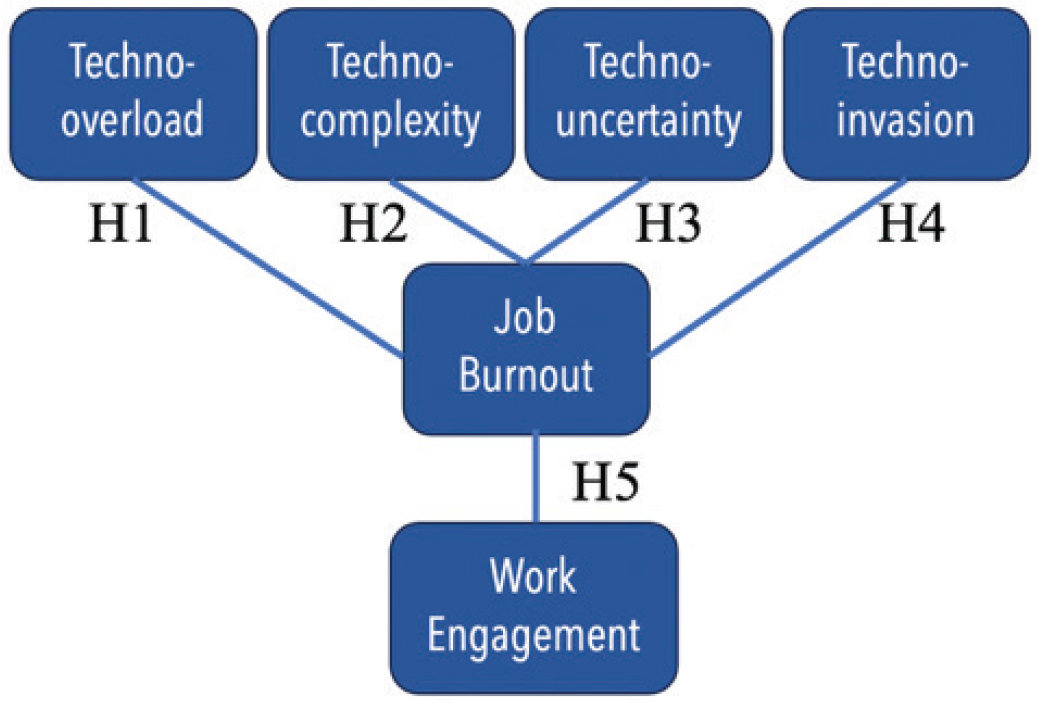
Fig. 1. Technostress research analysis model. Study hypotheses: H1. techno-overload has a positive effect on job burnout; H2. techno-complexity has a positive effect on job burnout; H3. techno-uncertainty has a positive effect on job burnout; H4. techno-invasion has a positive effect on job burnout; H5. job burnout has a negative relationship with work engagement.
A questionnaire modified from Ragu-Nathan et al.1 was used to quantify technostress (Appendix A). It consists of five primary dimensions: techno-overload (five items), techno-invasion (four items), techno-complexity (five items), techno-insecurity (five items), and techno-uncertainty (four items). This tool is intended to evaluate the degree of psychological stress brought on by using contemporary information technology (IT).1 A five-point Likert scale, with 1 denoting strongly disagree and 5 denoting strongly agree, was used to measure each item. Since the techno-insecurity dimension is irrelevant to the setting of healthcare workers, it was left out of the analysis. Limited technical proficiency is not a sufficient reason to substitute medical professionals.
Burnout was measured using the Maslach Burnout Inventory (MBI), which is widely used to assess the three dimensions of burnout: exhaustion (9 items), personal accomplishment (8 items), and cynicism (5 items).11 A seven-point Likert scale, with 0 representing never and 6 representing every day, was used to rate each item. The MBI questionnaire used in this study was modified to represent burnout conditions unique to Indonesian healthcare personnel (Appendix B).
The 17-item UWES, which has three primary dimensions—vigor, dedication, and absorption—was used to gauge work engagement. A seven-point Likert scale, with 0 denoting never and 6 denoting every day, was used to evaluate each item. The UWES is a dependable and trustworthy tool for evaluating an employee’s degree of involvement and psychological connection to their work.19 The components were modified to take into account the linguistic and cultural background of Indonesian medical professionals (Appendix C).
Data Analysis
Partial least squares structural equation modeling (PLS-SEM) with SmartPLS version 4 software was used to analyze the data. The PLS-SEM method was chosen because it is well-suited for datasets that do not follow a normal distribution and for its ability to test complex relationships between variables.20,21 The measuring model was first evaluated in order to determine its construct reliability, discriminant validity, and convergent validity. Convergent validity was evaluated using the average variance extracted (AVE) with a minimum threshold of 0.5, while construct reliability was measured using composite reliability (CR) and Cronbach’s alpha, both with a minimum acceptable value of 0.7.20
The structural model was then assessed using path coefficient testing to determine the relevance and strength of correlations between constructs after verification that the measurement model satisfied all requirements. In order to comprehend the process by which technostress affects healthcare professionals’ work engagement, the results were thoroughly evaluated.
Results
The characteristics of the 213 respondents who participated in this survey are summarized in Table 2.
From the collected data, validity and reliability testing used outer model evaluation with PLS-SEM. The outer model was assessed through convergent validity, AVE, Cronbach’s alpha, and CR, with the following criteria: outer loading > 0.6; AVE > 0.5; Cronbach’s Alpha > 0.7; CR > 0.7. To assess discriminant validity, the heterotrait-monotrait ratio (HTMT) was used, with an acceptable threshold of < 0.9.20
Table 3 lists the results of validity and reliability testing. The outer model analysis demonstrates that the validity and reliability of indicators for each construct met the required criteria. Although several indicators of job burnout (JPA2-JPA8) showed negative loadings, the absolute loading values remained acceptable (AVE > 0.50), consistent with burnout scales that frequently include reverse-worded items, which naturally produce negative loading values.20,21 Theoretically, these loadings measure emotional exhaustion in the opposite direction; therefore, negative loadings do not compromise construct validity and are retained in the analysis.
| Variable/Items | Outer loading (> 0.6) | Average variance extracted (> 0.5) | Cronbach’s alpha (> 0.7) | Composite reliability (> 0.7) |
| Techno-complexity | ||||
| TC1 | 0.841 | 0.739 | 0.911 | 0.934 |
| TC2 | 0.906 | |||
| TC3 | 0.908 | |||
| TC4 | 0.758 | |||
| TC5 | 0.877 | |||
| Techno-invasive | ||||
| TIV1 | 0.896 | 0.842 | 0.937 | 0.955 |
| TIV2 | 0.902 | |||
| TIV3 | 0.943 | |||
| TIV4 | 0.927 | |||
| Techno-overload | ||||
| TO1 | 0.714 | 0.639 | 0.862 | 0.897 |
| TO2 | 0.742 | |||
| TO3 | 0.901 | |||
| TO4 | 0.739 | |||
| TO5 | 0.880 | |||
| Techno-uncertainty | ||||
| TU1 | 0.779 | 0.742 | 0.885 | 0.920 |
| TU2 | 0.920 | |||
| TU3 | 0.865 | |||
| TU4 | 0.874 | |||
| Job burnout | ||||
| JC1 | 0.707 | 0.539 | 0.792 | 0.806 |
| JC2 | 0.676 | |||
| JC3 | 0.678 | |||
| JC4 | 0.799 | |||
| JC5 | 0.805 | |||
| JE1 | 0.720 | |||
| JE2 | 0.824 | |||
| JE3 | 0.779 | |||
| JE4 | 0.867 | |||
| JE5 | 0.660 | |||
| JE6 | 0.868 | |||
| JE7 | 0.832 | |||
| JE8 | 0.832 | |||
| JE9 | 0.771 | |||
| JPA2 | -0.704 | |||
| JPA3 | -0.650 | |||
| JPA4 | -0.582 | |||
| JPA5 | -0.515 | |||
| JPA6 | -0.661 | |||
| JPA7 | -0.623 | |||
| JPA8 | -0.739 | |||
| Work engagement | ||||
| WA1 | 0.636 | 0.582 | 0.943 | 0.943 |
| WA3 | 0.840 | |||
| WA5 | 0.755 | |||
| WA6 | 0.617 | |||
| WD1 | 0.600 | |||
| WD2 | 0.912 | |||
| WD3 | 0.832 | |||
| WD4 | 0.767 | |||
| WV1 | 0.881 | |||
| WV2 | 0.918 | |||
| WV3 | 0.754 | |||
| WV4 | 0.771 | |||
| WV5 | 0.662 | |||
| WV6 | 0.626 | |||
| Note: TC1-TC5 represent indicators of techno-complexity; TIV1-TIV4 represent indicators of techno-invasion; TO1-TO5 represent indicators of techno-overload; TU1-TU4 represent indicators of techno-uncertainty; JC1-5, JE1-9, JPA2-8 represent indicators of job burnout; and WA1-6, WD1-4, WV1-6 represent indicators of work engagement. Outer loadings represent standardized factor loadings. AVE = average variance extracted; CR = composite reliability. Values represent standardized coefficients obtained from the Partial Least Squares Structural Equation Modeling analysis. Heterotrait-Monotrait ratio (HTMT < 0.9).20 | ||||
Data from Table 3 also reveal that all AVE values were greater than 0.5 (range 0.539–0.842), Cronbach’s alpha > 0.7 (range 0.792–0.943), and CR > 0.7 (range 0.806–0.955). This indicates that each construct explains more than half of the variance in its indicators, demonstrating adequate convergent validity. Based on these evaluations, it can be concluded that all indicators are consistent and reliable in measuring their respective constructs.
Discriminant validity was assessed using the HTMT. Table 4 shows that all HTMT values were below the threshold of 0.90,20 ranging from 0.407 to 0.917, indicating that each construct demonstrated adequate conceptual distinctiveness.
| Variable | Job burnout | Techno-complexity | Techno-invasive | Techno-overload | Techno-uncertainty | Work engagement | |
| Job burnout | 0.734 | ||||||
| Techno-complexity | 0.566 | 0.860 | |||||
| Techno-invasive | 0.543 | 0.684 | 0.917 | ||||
| Techno-overload | 0.407 | 0.791 | 0.689 | 0.799 | |||
| Techno-uncertainty | 0.422 | 0.470 | 0.407 | 0.428 | 0.861 | ||
| Work engagement | -0.810 | -0.359 | -0.371 | -0.233 | -0.191 | 0.763 | |
| Note: Values represent the Heterotrait-Monotrait ratio (HTMT) obtained from Partial Least Squares Structural Equation Modeling analysis and are standardized coefficients without measurement units. HTMT values below 0.90 indicate adequate discriminant validity. 22 | |||||||
Structural model analysis was then conducted to evaluate the hypothesized relationships among the variables in this study. The results of the structural model analysis are presented in Table 5. The findings indicate that techno-complexity has a positive and significant relationship with job burnout (β = 0.460, t = 4.823, p < 0.001). Techno-invasion also demonstrated a positive and significant relationship with job burnout (β = 0.339, t = 4.820, p < 0.001). In contrast, techno-overload showed a significant but negative effect on job burnout (β = –0.268, t = 2.762, p = 0.006). Furthermore, techno-uncertainty had a positive and significant relationship with job burnout (β = 0.182, t = 2.529, p = 0.012). Lastly, job burnout demonstrated a strong negative effect on Work Engagement (β = –0.810, t = 28.850, p < 0.001).
To ascertain if job burnout acts as an intervening mechanism connecting the aspects of technostress to work engagement, mediation analysis was carried out. Table 6 illustrates that job burnout had a significant indirect influence of techno-complexity on work engagement (β = –0.373, t = 4.651, p < 0.001). Additionally, techno-invasion showed a substantial negative indirect effect on work engagement through job burnout (β = –0.274, t = 4.706, p < 0.001).
Feeling overwhelmed by technology actually had a surprising positive effect on work engagement. In other words, when healthcare professionals used technology intensively, it seemed to lower their burnout levels and made them more engaged in their work. On the other hand, frequent changes or updates in technology created uncertainty that increased burnout and, as a result, decreased their enthusiasm for work. Overall, these results show that burnout plays a key role in connecting how technostress affects healthcare workers’ motivation and involvement in their jobs.
The explanatory power of endogenous factors in the study model was assessed using the coefficient of determination (R2). Table 7 displays the R2 results. The construct job burnout has an R2 value of 0.412, meaning that the dimensions of technostress account for 41.2% of the variance in job burnout. According to the criteria put forth by Hair et al., this value is categorized as moderate, indicating that while technostress is a factor in burnout, other factors outside the research model also have an impact.20 Work Engagement showed a strong R2 value of 0.656. This shows a robust predictive link, with job burnout accounting for 65.6% of the variance in work engagement. These findings highlight the important psychological process that burnout plays in determining healthcare professionals’ degree of work engagement.
| Construct | R2 | Category | |
| Job burnout | 0.412 | Moderate | |
| Work engagement | 0.656 | Substantial | |
| R2: coefficient of determination. | |||
Discussion
EHRs have the potential to improve the efficacy, safety, and quality of healthcare services.22,23 However, adopting EHRs might cause technostress for some healthcare personnel, which can lead to burnout.10,23 The high demands of their profession and the rapid speed of digital transformation in healthcare services make healthcare workers especially susceptible to work-related stress. The setting in which healthcare workers are employed also influences work engagement and job satisfaction, both of which are shaped by the emotional demands and workload associated with different clinical environments.23–25 Rao et al. emphasized that workplace engagement is also essential for physicians.4
The results of this study reveal that job burnout is positively correlated with techno-complexity, techno-invasion, and techno-uncertainty. These findings are consistent with earlier research demonstrating that the intricacy of new technologies, the intrusion of work into personal time through digital tools, and the continuous uncertainty associated with continuously changing health information systems all contribute to increased burnout among healthcare workers.23–25 Several EHR design-related factors have been linked to elevated stress and burnout, including slow system performance, difficulty navigating the interface efficiently, excessive documentation, fear of overlooking important information, disruption of the patient-clinician relationship, and practices that prioritize billing over patient care.24 In addition, a study conducted in Swiss psychiatric hospitals showed that physicians and nurses experience the greatest levels of technostress among all hospital staff, largely due to a mismatch between the effort required to use technology and the benefits it provides. This study also reported a positive association between technostress and burnout symptoms.26
This result could be explained by a lack of experience of healthcare professionals with recently introduced EHR systems, which makes them feel inadequate when utilizing the technology. It becomes essential to continuously adapt to sophisticated technological systems, especially in environments where errors can have serious consequences.27 The blurring of work-life boundaries due to constant connectivity and expectation of availability may exacerbate emotional tiredness and have a detrimental effect on the mental health healthcare workers. This persistent intrusion increases stress and accelerates burnout.28 Rapid and unpredictable changes in technology force employees to continually update their skills, creating ongoing anxiety and a sense of instability. This uncertainty increases emotional strain, further fueling burnout.29 Furthermore, the lengthening time needed to run electronic equipment could also cause technostress, which would eventually result in burnout.23,30,31
Based on the results presented here, techno-overload has a negative correlation with job burnout and a positive indirect effect on work engagement that is mediated by a decrease in burnout. These findings contrast with earlier research27,28 that found a higher risk of burnout when healthcare personnel were “forced” to work quicker because of a greater workload or information workload. Multiple systematic reviews and empirical studies consistently report that techno-overload leads to higher emotional exhaustion and burnout.27,28
Kaltenegger et al.,27 also identified techno-overload as a significant predictor of burnout. Although this finding appears contradictory to early technostress theory, it aligns with the concept of techno-eustress, a positive and constructive form of technostress in which stress originating from technology is perceived as a motivating challenge rather than a hindrance. In this context, individuals view technological use as an opportunity to learn, enhance efficiency, and acquire new skills.27,32,33 The key factor is how individuals interpret technology demands, seeing them as challenges to overcome rather than threats.34 Better EHR usability and higher informatics competence are found linked to better healthcare workers and patient outcomes.35 According to Tarafdar et al., the results may also be indicative of an adaptive technostress response, in which frequent use of technology increases familiarity, speed, and workflow efficiency.34 Furthermore, a protective factor that reduces perceived load and eventually improves work engagement may be provided by enough institutional support, such as appropriate training, sufficient IT support, and technical assistance28.
Work Engagement and job burnout showed a significant negative correlation in this study. This validates the study’s hypothesis that job burnout is negatively correlated with work engagement, which is in line with earlier research demonstrating a negative correlation between these constructs, with burnout-affected healthcare workers exhibiting lower work engagement.12–14 These results are also consistent with the research of Hafstad et al.,36 which showed a dialectical link between burnout and work engagement, indicating that these two states might co-occur and dynamically impact one another rather than just being opposites.
By distinguishing the roles of distinct technostress dimensions in influencing burnout, the study’s findings add to the body of knowledge on technostress in healthcare. This study emphasizes that not all variables have the same direction or degree of influence, in contrast to earlier research that frequently considered technostress as a single, cohesive entity. These results have significant practical ramifications for controlling technostress in healthcare settings, especially when it comes to the deployment of digital health systems such as EHR. The need to streamline digital systems, enhance usability, and reduce technological intrusions outside of working hours is highlighted by the beneficial and substantial effects of techno-complexity and techno-invasion on burnout.37 To help healthcare personnel handle technological complexity without feeling more psychologically strained, healthcare organizations should offer sufficient training and encourage the development of digital capabilities.38
Techno-uncertainty and job burnout are positively correlated, which suggests that in order to reduce stress, system changes must be effectively explained and supported by organized change management techniques. The detrimental impact of techno-overload on burnout implies that, when combined with user familiarity and appropriate adaptation, technology use can serve as a facilitating resource that improves efficiency.38,39 This highlights the significance of thorough training and sufficient assistance for healthcare professionals to make the best use of technology, enabling digital tools to function as facilitators rather than burdens. The importance of reducing burnout is further shown by the substantial negative correlation between job burnout and work engagement, which may have a favorable effect on productivity and the standard of healthcare services.40,41 To maximize technology’s potential as a helpful tool in the provision of healthcare services, a comprehensive strategy that incorporates organizational support, training, and human-centered technology design is required.28
These findings suggest that interventions should be targeted to tackle the specific technostressors affecting each group, rather than utilizing a one-size-fits-all strategy. Identifying which technostressors have the highest impact enables organizations to allocate resources more efficiently, such as prioritizing IT support, training, or process redesign where they are most needed. Some technostressors may have positive characteristics; therefore, solutions should aim to limit harm while retaining or boosting possible advantages.26,38,42
Limitations
This study’s primary drawback is its cross-sectional design, which limits the capacity to make compelling causal inferences. To gain a deeper understanding of the dynamics of the links between burnout and technostress aspects across time, longitudinal studies are required. Furthermore, social desirability bias, perceptual bias, interpretive bias, and respondent weariness are concerns associated with the self-reported nature of the data.
Future studies may incorporate direct data collection methods, such as interviews, to reduce these biases. Moreover, this study did not analyze the influence of respondents’ demographic or professional characteristics, which may affect the development of technostress, job burnout, and work engagement. Future research should examine these characteristics, such as age groups and job types, to enable organizations to design more targeted managerial interventions for employee groups at higher risk of work-related stress or burnout. Future multiprovince longitudinal studies with probability sampling across rural/urban facilities are needed to confirm mediation pathways and explore EHR implementation phases.
Conclusion
The links among the characteristics of technostress, job burnout, and work engagement among EHR-using healthcare professionals were investigated in this study. The results show that stressors that considerably raise job burnout include techno-complexity, techno-invasion, and techno-uncertainty. On the other hand, techno-overload showed a strong impact in lowering job burnout, indicating a techno-eustress reaction. Furthermore, work engagement was significantly impacted negatively by job fatigue. These results emphasize how crucial it is for healthcare organizations to promote digital competency and a positive work environment in addition to lowering technology-driven expectations through enhanced usability and workflow integration. These initiatives can help turn the use of technology from a burden to a resource that improves the provision of healthcare services.
Contributions
Angellica Subianto Tan: Conceptualization, data curation, formal analysis, methodology, writing—original draft preparation. Steffi Putri Erlani Hidayat: Conceptualization, data curation, investigation, writing—original draft preparation. Yohana F. Cahya Palupi Meilani: Conceptualization, supervision, project administration, writing—reviewing and editing.
Data Availability Statement (DAS), Data Sharing, Reproducibility, And Data Repositories
The datasets generated and analyzed during the current study are available from the corresponding author upon reasonable request. De-identified data may be shared for academic purposes. The study methodology and statistical analyses are described in sufficient detail to allow replication. No public data repository was used for this study.
Application of AI-Generated Text or Related Technology
No AI-generated text or tools were used in manuscript preparation beyond basic grammar checks. All scientific content, analysis, and interpretations were developed and verified by the authors.
Acknowledgments
The authors would like to thank the healthcare professionals who participated in this study. They also appreciate the insightful comments and guidance provided by colleagues throughout the development of this manuscript.
References
- Ragu-Nathan TS, Tarafdar M, Ragu-Nathan BS, Tu Q. The consequences of technostress for end users in organizations: conceptual development and empirical validation. Inform Syst Res. 2008;19(4):417–33. https://doi.org/10.1287/isre.1070.0165
- Vargas-Benítez MÁ, Izquierdo-Espín FJ, Castro-Martínez N, Gómez-Urquiza JL, Albendín-García L, Velando-Soriano A, et al. Burnout syndrome and work engagement in nursing staff: a systematic review and meta-analysis. Front Med. 2023;10:1125133. https://doi.org/10.3389/fmed.2023.1125133
- Edú-Valsania S, Laguía A, Moriano JA. Burnout: a review of theory and measurement. Int J Environ Res Public Health. 2022;19(3):1780. https://doi.org/10.3390/ijerph19031780
- Rao S, Ferris TG, Hidrue MK, Lehrhoff SR, Lenz S, Heffernan J, et al. Physician burnout, engagement and career satisfaction in a large academic medical practice. Clin Med Res. 2020;18(1):3–10. https://doi.org/10.3121/cmr.2019.1516
- Bakker AB. The social psychology of work engagement: state of the field. Career Dev Int. 2022;27(1):36–53. https://doi.org/10.1108/CDI-08-2021-0213
- Amalia N, Rustam MZA, Rosarini A, Wijayanti DR, Riestiyowati MA. The implementation of electronic medical record (EMR) in the development health care system in Indonesia. Int J Advance Life Sci Res. 2021;4(3):8–12. https://doi.org/10.31632/ijalsr.2021.v04i03.002
- Babiker M, Merisalu E, Roja Z. Exploration of the association between technostress and burnout among healthcare professionals. Int J Soc Rel Concern. 2024;12(3):29–41. https://doi.org/10.26821/IJSRC.12.3.2024.120306
- Ficapal-Cusí P, Torrent-Sellens J, Yuguero O. Technostress among healthcare professionals in SpaIn: a cross-sectional survey on the impact of digital health tools. BMJ Open. 2025;15(9):e103783. https://doi.org/10.1136/bmjopen-2025-103783
- Tajirian T, Stergiopoulos V, Strudwick G, Sequeira L, Sanches M, Kemp J, et al. The influence of electronic health record use on physician burnout: cross-sectional survey. J Med Internet Res. 2020;22(7):e19274. https://doi.org/10.2196/19274
- Budd J. Burnout related to electronic health record use in primary care. J Prim Care Community Health. 2023;14:21501319231166921. https://doi.org/10.1177/21501319231166921
- Maslach C, Jackson S, Leiter M. Maslach Burnout Inventory manual. 3rd ed. Palo Alto, CA: Consulting Psychologists Press; 1996.
- Bernales-Turpo D, Quispe-Velasquez R, Flores-Ticona D, Saintila J, Ruiz Mamani PG, Huancahuire-Vega S, et al. Burnout, professional self-efficacy, and life satisfaction as predictors of job performance in health care workers: the mediating role of work engagement. J Prim Care Community Health. 2022;13:21501319221101845. https://doi.org/10.1177/21501319221101845
- Munn LT, O’Connell N, Huffman C, McDonald S, Gibbs M, Miller C, et al. Job-related factors associated with burnout and work engagement in emergency nurses: evidence to inform systems-focused interventions. J Emerg Nurs. 2025;51(2):249–60. https://doi.org/10.1016/j.jen.2024.10.007
- Chan AO, Chan YH, Chuang KP, Ng JS, Neo PS. Addressing physician quality of life: understanding the relationship between burnout, work engagement, compassion fatigue and satisfaction. J Hosp Admin. 2015;4(6):46. https://doi.org/10.5430/jha.v4n6p46
- Alexias G, Papandreopoulou M, Togas C. Work engagement and burnout in a private healthcare unit in Greece. Int J Environ Res Public Health. 2024;21(2):130. https://doi.org/10.3390/ijerph21020130
- Perepelkin J, Wilson GA. The mediating role of burnout in the anxiety and work engagement relationship. J Health Manag. 2023;25(4):860–9. https://doi.org/10.1177/09720634231215143
- Widhianingtanti LT, Luijtelaar GV. The Maslach-Trisni Burnout Inventory: adaptation for Indonesia. JP3I. 2022;11(1):1–21. https://doi.org/10.15408/jp3i.v11i1.24400
- Hapsari EA, Rohmatullayaly EN, Widayati KA. Technostress and sleep quality among university students in Indonesia: a cross-sectional study. Asian J Soc Health Behav. 2024;7(4):197–202. https://doi.org/10.4103/shb.shb_177_24
- Schaufeli W, Bakker A. Utrecht Work Engagement Scale: preliminary manual. Occupational Health Psychology Unit, Utrecht University.
- Hair JF, Hult GTM, Ringle CM, Sarstedt M, Danks NP, Ray S. Partial least squares structural equation modeling (PLS-SEM) using R: a workbook. Cham: Springer International Publishing; 2021. (Classroom Companion: Business). https://doi.org/10.1007/978-3-030-80519-7
- Hair JF, Risher JJ, Sarstedt M, Ringle CM. When to use and how to report the results of PLS-SEM. Eur Bus Rev. 2019;31(1): 2–24. https://doi.org/10.1108/EBR-11-2018-0203
- Bernburg M, Tell A, Groneberg DA, Mache S. Digital stressors and resources perceived by emergency physicians and associations to their digital stress perception, mental health, job satisfaction and work engagement. BMC Emerg Med. 2024;24(1):31. https://doi.org/10.1186/s12873-024-00950-x
- Muhamad NA, Ma’amor NH, Jamalluddin NH, Rosli IA, Leman FN, Tengku Baharudin Shah TPN, et al. Technostress and its associated factors: burnout and fatigue among Malaysian healthcare workers (HCWs) in state hospitals. PLoS One. 2025;20(3):e0319506. https://doi.org/10.1371/journal.pone.0319506
- Bail C, Harth V, Mache S. Digitalization in urology—a multimethod study of the relationships between physicians’ technostress, burnout, work engagement and job satisfaction. Healthcare. 2023;11(16):2255. https://doi.org/10.3390/healthcare11162255
- Issa H, Jaber J, Lakkis H. Navigating AI unpredictability: exploring technostress in AI-powered healthcare systems. Technol Forecast Soc Change. 2024;202:123311. https://doi.org/10.1016/j.techfore.2024.123311
- Golz C, Peter KA, Müller TJ, Mutschler J, Zwakhalen SMG, Hahn S. Technostress and digital competence among health professionals in Swiss psychiatric hospitals: cross-sectional study. JMIR Ment Health. 2021;8(11):e31408. https://doi.org/10.2196/31408
- Kaltenegger HC, Becker L, Rohleder N, Nowak D, Quartucci C, Weigl M. Associations of technostressors at work with burnout symptoms and chronic low-grade inflammation: a cross-sectional analysis in hospital employees. Int Arch Occup Environ Health. 2023;96(6):839–56. https://doi.org/10.1007/s00420-023-01967-8
- Wirth T, Kräft J, Marquardt B, Harth V, Mache S. Indicators of technostress, their association with burnout and the moderating role of support offers among nurses in German hospitals: a cross-sectional study. BMJ Open. 2024;14(7):e085705. https://doi.org/10.1136/bmjopen-2024-085705
- Thanasrivanitchai J, Torasamphan T. The effect of technostress to employee’s job burnout in organization within Thailand. In: 2024 Portland International Conference on Management of Engineering and Technology (PICMET) [Internet]. Portland, OR: IEEE; 2024 [cited 2025 Dec 3]. p. 1–6. Available from: https://ieeexplore.ieee.org/document/10653255/
- Shaban M, Ezzelregal Abdelgawad M, Mohamed Elsayed S, Mohamed Abdallah HM. The mediating role of emotional intelligence in the relationship between technostress and burnout prevention among critical care nurses a structural equation modelling approach. BMC Nurs. 2025;24(1):255. https://doi.org/10.1186/s12912-025-02852-0
- Harris DA, Haskell J, Cooper E, Crouse N, Gardner R. Estimating the association between burnout and electronic health record-related stress among advanced practice registered nurses. Appl Nurs Res. 2018;43:36–41. https://doi.org/10.1016/j.apnr.2018.06.014
- Kopuz K, Turgut M, Aydın G. Technostress among nurses: boon or bane? The moderated mediation model. BMC Nurs. 2025;24(1):1092. https://doi.org/10.1186/s12912-025-03721-6
- Sanjeeva Kumar P. TECHNOSTRESS: a comprehensive literature review on dimensions, impacts, and management strategies. Comput Hum Behav Rep. 2024;16:100475. https://doi.org/10.1016/j.chbr.2024.100475
- Tarafdar M, Cooper CL, Stich J. The technostress trifecta – techno eustress, techno distress and design: theoretical directions and an agenda for research. Inform Syst J. 2019;29(1):6–42. https://doi.org/10.1111/isj.12169
- Kaihlanen AM, Gluschkoff K, Hyppönen H, Kaipio J, Puttonen S, Vehko T, et al. The associations of electronic health record usability and user age with stress and cognitive failures among Finnish registered nurses: cross-sectional study. JMIR Med Inform. 2020;8(11):e23623. https://doi.org/10.2196/23623
- Hafstad MD, Ebrahimi OV, Fostervold KI. The dialectical relationship between burnout and work engagement: a network approach. Stress Health. 2025;41(2):e3514. https://doi.org/10.1002/smi.3514
- Kidayi MA, Stephano EE, Sellah ZJ, Mtoro MJ, Min Y. Nursing informatics competence and its associated factors among nurses in Tanzania: a cross-sectional study. BMC Nurs. 2025;24(1):1077. https://doi.org/10.1186/s12912-025-03703-8
- Keshavarz H, Saeidnia HR, Wang T. Navigating technostress: a deep dive into health practitioners’ technological challenges in hospital settings. BMC Health Serv Res. 2025;25(1):18. https://doi.org/10.1186/s12913-024-12196-1
- Kaihlanen AM, Gluschkoff K, Laukka E, Heponiemi T. The information system stress, informatics competence and well-being of newly graduated and experienced nurses: a cross-sectional study. BMC Health Serv Res. 2021;21(1):1096. https://doi.org/10.1186/s12913-021-07132-6
- Würtenberger A, Groneberg DA, Mache S. Digital stress perception and associations with work- and health-related outcomes among general practitioners in Germany: a quantitative study. BMC Health Serv Res. 2025;25(1):535. https://doi.org/10.1186/s12913-025-12653-5
- Mohan V, Garrison C, Gold JA. Using a new model of electronic health record training to reduce physician burnout: a plan for action. JMIR Med Inform. 2021;9(9):e29374. https://doi.org/10.2196/29374
- Stadin M, Nordin M, Fransson EI, Broström A. Healthcare managers’ experiences of technostress and the actions they take to handle it—a critical incident analysis. BMC Med Inform Decis Mak. 2020;20(1):244. https://doi.org/10.1186/s12911-020-01261-4
- Modi S, Feldman SS. The value of electronic health records since the health information technology for economic and clinical health act: systematic review. JMIR Med Inform. 2022;10(9):e37283. https://doi.org/10.2196/37283
- Hossain MdK, Sutanto J, Handayani PW, Haryanto AA, Bhowmik J, Frings-Hessami V. An exploratory study of electronic medical record implementation and recordkeeping culture: the case of hospitals in Indonesia. BMC Health Serv Res. 2025;25(1):249. https://doi.org/10.1186/s12913-025-12399-0
Copyright Ownership: This is an open-access article distributed in accordance with the Creative Commons Attribution Non-Commercial (CC BY-NC 4.0) license, which permits others to distribute, adapt, enhance this work non-commercially, and license their derivative works on different terms, provided the original work is properly cited and the use is non-commercial. See http://creativecommons.org/licenses/by-nc/4.0. The authors of this article own the copyright.
| Item/Original statement | Modified statement | Subscale | Notes | |
| Technostress by Ragu-Nathan et al. | ||||
| 1. | I am forced by this technology to work much faster. | I am forced by EHRs to work much faster. | Techno-overload | Modified |
| 2. | I am forced by this technology to do more work than I can handle. | I am forced by EHRs to do more work than I can handle. | Techno-overload | Modified |
| 3. | I am forced by this technology to work with very tight time schedules. | I am forced by EHR to work with very tight schedule. | Techno-overload | Modified |
| 4. | I am forced to change my work habits to adapt to new technologies. | I am forced to change my work habits to adapt to EHRs. | Techno-overload | Modified |
| 5. | I have a higher workload because of increased technology complexity. | I have a higher workload because of increased EHRs complexity. | Techno-overload | Modified |
| 6. | I spend less time with my family due to this technology. | I spend less time with my family due to EHRs. | Techno-invasion | Modified |
| 7. | I have to be in touch with my work even during my vacation due to this technology. | I have to be in touch with my work even during my vacation due to EHRs. | Techno-invasion | Modified |
| 8. | I have to sacrifice my vacation and weekend time to keep current on new technologies. | I have to sacrifice my vacation and weekend time to keep current on EHRs. | Techno-invasion | Modified |
| 9. | I feel my personal life is being invaded by this technology. | I feel my personal life is being invaded by EHRs. | Techno-invasion | Modified |
| 10. | I do not know enough about this technology to handle my job satisfactorily. | I do not know enough about EHRs to handle my job satisfactorily. | Techno-complexity | Modified |
| 11. | I need a long time to understand and use new technologies. | I need a long time to understand and use EHRs. | Techno-complexity | Modified |
| 12. | I do not find enough time to study and upgrade my technology skills. | I do not find enough time to study and upgrade my EHRs skills. | Techno-complexity | Modified |
| 13. | I find new recruits to this organization know more about computer technology than I do. | I find new recruits to this organization know more about EHRs than I do. | Techno-complexity | Modified |
| 14. | I often find it too complex for me to understand and use new technologies. | I often find it too complex for me to understand and use EHRs. | Techno-complexity | Modified |
| 15. | There are always new developments in the technologies we use in our organization. | There are always new developments in EHRs that we use in our organization. | Techno-uncertainty | Modified |
| 16. | There are constant changes in computer software in our organization. | There are constant changes in computer software in our organization. | Techno-uncertainty | Unmodified |
| 17. | There are constant changes in computer hardware in our organization. | There are constant changes in computer hardware in our organization. | Techno-uncertainty | Unmodified |
| 18. | There are frequent upgrades in computer networks in our organization. | There are frequent upgrades in computer networks in our organization. | Techno-uncertainty | Unmodified |
| Maslach Burnout Inventory—Human Services Survey | ||||
| 19. | I feel emotionally drained from my work. | I feel emotionally drained from my work. | Exhaustion | Unmodified |
| 20. | Working with people directly puts too much stress on me. | Working directly with patients puts too much stress on me. | Exhaustion | Modified |
| 21. | I feel like I’m at the end of my rope. | I feel like I’m at the end of my rope. | Exhaustion | Unmodified |
| 22. | I feel frustrated by my job. | Working as a healthcare professional makes me feel frustrated. | Exhaustion | Modified |
| 23. | I feel I’m working too hard on my job. | I feel I’m working too hard on my job. | Exhaustion | Unmodified |
| 24. | Working with people all day is really a strain for me. | Dealing with patients all day is really a strain for me. | Exhaustion | Modified |
| 25. | I feel burned out from my work. | I feel burned out from my work. | Exhaustion | Unmodified |
| 26. | I feel fatigued when I get up in the morning and have to face another day on the job. | I feel fatigued when I get up in the morning and have to face another day working with patients. | Exhaustion | Modified |
| 27. | I feel used up at the end of the workday. | I feel used up at the end of the workday. | Exhaustion | Unmodified |
| 28. | I have accomplished many worthwhile things in this job. | I have accomplished many worthwhile things in this job. | Personal accomplishment | Unmodified |
| 29. | I feel very energetic. | I feel very energetic when interacting with my patients. | Personal accomplishment | Modified |
| 30. | I can easily understand how my recipients feel about things. | I can easily understand the feelings and expectations of my patients. | Personal accomplishment | Modified |
| 31. | I deal very effectively with the problems of my recipients. | I am able to serve my patients effectively. | Personal accomplishment | Modified |
| 32. | In my work, I deal with emotional problems very calmly. | In my work, I deal with emotional problems very calmly. | Personal accomplishment | Unmodified |
| 33. | I feel I’m positively influencing other people’s lives through my work. | I feel that I make a positive impact on other people’s lives through my work as a healthcare professional. | Personal accomplishment | Modified |
| 34. | I can easily create a relaxed atmosphere with my recipients. | I can easily create a relaxed atmosphere with my patients. | Personal accomplishment | Modified |
| 35. | I feel exhilarated after working closely with my recipients. | I feel exhilarated after working closely with my patients. | Personal accomplishment | Modified |
| 36. | I feel I treat some recipients as if they were impersonal “object. | I feel I treat some patients as if they were impersonal “object. | Cynicism | Modified |
| 37. | I feel recipients blame me for some of their problems. | I feel patients blame me for some of their problems. | Cynicism | Modified |
| 38. | I don’t really care what happens to some recipients. | I don’t really care what happens to some patients. | Cynicism | Modified |
| 39. | I’ve become more callous toward people since I took this job. | I have become increasingly indifferent toward others since I started working as a healthcare professional. | Cynicism | Modified |
| 40. | I worry that this job is hardening me emotionally. | I worry that this job is hardening me emotionally. | Cynicism | Unmodified |
| Utrecht Work Engagement Scale | ||||
| 41. | At my work, I feel bursting with energy. | At my work, I feel bursting with energy. | VI1 | Unmodified |
| 42. | I find the work that I do full of meaning and purpose. | I find the work that I do full of meaning and purpose. | DE1 | Unmodified |
| 43. | Time flies when I’m working. | Time just flies when I am attending to patients. | AB1 | Modified |
| 44. | At my job, I feel strong and vigorous. | At my job, I feel strong and vigorous. | VI2 | Unmodified |
| 45. | I am enthusiastic about my job. | I am enthusiastic about my job. | DE2 | Unmodified |
| 46. | When I am working, I forget everything else around me. | When I am attending to patients, I forget everything else around me. | AB2 | Modified |
| 47. | My job inspires me. | My job inspires me. | DE3 | Unmodified |
| 48. | When I get up in the morning, I feel like going to work. | When I get up in the morning, I feel like going to work. | VI3 | Unmodified |
| 49. | I feel happy when I am working intensely. | I feel happy when I am working intensely. | AB3 | Unmodified |
| 50. | I am proud of the work that I do. | I am proud of the work that I do. | DE4 | Unmodified |
| 51. | I am immersed in my work. | I am immersed in my work. | AB4 | Unmodified |
| 52. | I can continue working for very long periods at a time. | I can continue working for very long periods at a time. | VI4 | Unmodified |
| 53. | To me, my job is challenging. | To me, my job is challenging. | DE5 | Unmodified |
| 54. | I get carried away when I’m working. | I get carried away when I’m working. | AB5 | Unmodified |
| 55. | At my job, I am very resilient, mentally. | At my job, I am very resilient, mentally. | VI5 | Unmodified |
| 56. | It is difficult to detach myself from my job. | It is difficult to detach myself from my job. | AB6 | Unmodified |
| 57. | At my work I always persevere, even when things do not go well. | At my work I always persevere, even when things do not go well. | VI6 | Unmodified |
| AB1: Time flies when I’m working. AB2: When I am working, I forget everything else around me. AB3: I feel happy when I am working intensely. AB4: I am immersed in my work. AB: Absorption. AB5: I get carried away when I’m working. AB6: It is difficult to detach myself from my job. DE: Dedication. DE1: I find the work that I do full of meaning and purpose. DE2: I am enthusiastic about my job. DE3: My job inspires me. DE4: I am proud of the work that I do. DE5: To me, my job is challenging. VI: Vigor. VI: At my job, I am very resilient, mentally. VI1: At my work, I feel bursting with energy. VI2: At my job, I feel strong and vigorous. VI3: When I get up in the morning, I feel like going to work. VI4: I can continue working for very long periods. VI5: At my job, I am very resilient, mentally. VI6: At my work I always persevere, even when things do not go well. | ||||