The Disruptive Impact of Agentic AI on Medical Schools
DOI:
https://doi.org/10.30953/thmt.v10.639Keywords:
agenticAI, digitalhealth, healthAI, medical education, medical school curriculum, teaching hospitalAbstract
As artificial intelligence evolves from a supportive tool to an autonomous agent, the foundations of medical education face a seismic shift. In this THMT Podcast episode, we explore how agentic AI systems - capable of independent decision making, reasoning, and adaptive learning, is transforming how future physicians are trained, assessed, and accredited. What happens when core disciplines like pathology, radiology, and diagnostics become largely automated? How do we redefine the educator’s role, ensure equity in access, and prepare clinicians for a future where human judgment and machine intelligence must seamlessly coexist? Join distinguished guests as they unpack the challenges and opportunities shaping the next generation of medical education.
Topics discussed by experts include:
- Defining the Disruption
When we say “agentic AI,” what exactly do we mean in the context of medical education—and how is it different from prior waves of AI or digital learning tools? - From Augmentation to Autonomy
Medical curricula have traditionally leaned on faculty expertise and structured pathways. How might agentic AI shift the balance between educator-led and learner-driven knowledge acquisition? - Skills for the Next Generation
If AI can personalize education at scale, what core skills should we prioritize in training future clinicians—knowledge mastery, critical thinking, adaptability, or something new entirely? - Equity and Access
Agentic AI has the potential to democratize learning—or deepen divides. How do we ensure rural learners, resource-limited institutions, and global partners benefit rather than being left behind? - Assessment and Accreditation
How do accrediting bodies and licensing boards adapt when AI can tailor assessments, simulate clinical encounters, and even suggest competency progression? What risks do you see if regulation lags behind innovation? - Ethics and the Educator’s Role
If learners increasingly interact with agentic AI tutors or copilots, what remains uniquely human—and irreplaceable—about the educator’s role in medicine?
Speakers
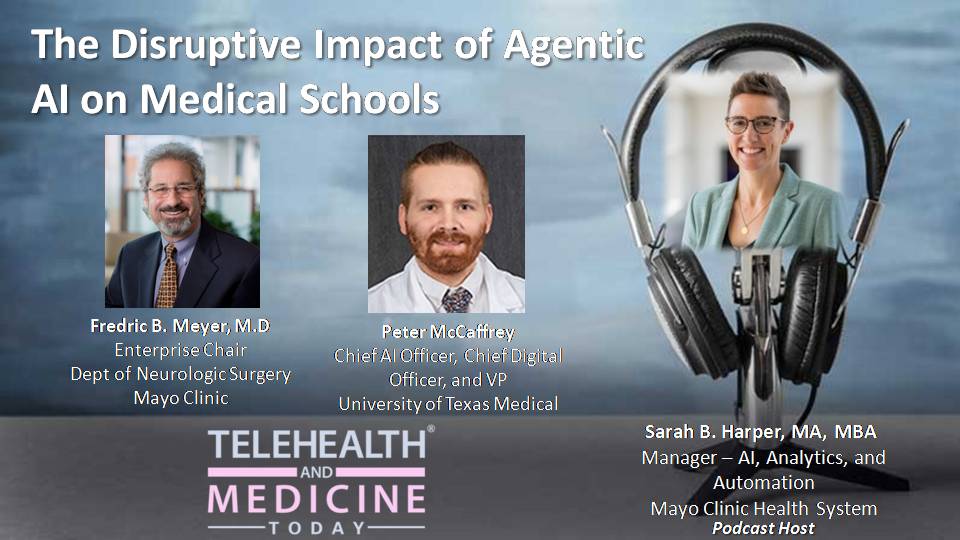
Fredric B. Meyer, M.D. is enterprise chair of the Department of Neurologic Surgery at Mayo Clinic and is recognized with the distinction of a named professorship, the Alfred Uihlein Family Professorship in Neurologic Surgery. He is currently the Juanita Kious Waugh Executive Dean of Education of the Mayo Clinic College of Medicine and Science and Dean of the Mayo Clinic Alix School of Medicine. Dr. Meyer earned obtained his M.D. degree at Boston University and then trained in general surgery, neurosurgery and cerebrovascular research at Mayo Graduate School of Medicine. He served as Chair of the Department of Neurologic Surgery at Mayo Clinic from 2004 to 2015. Dr. Meyer has held many leadership positions in professional organizations, including President of the American Academy of Neurological Surgery and Board of Directors of the American Association of Neurological Surgeons. He has been Director, Secretary, Chair and Executive Director of the American Board of Neurological Surgery.
Peter McCaffrey is currently Chief AI Officer, Chief Digital Officer, and VP at the University of Texas Medical Branch. He also currently serves as Chair of the University of Texas System's REAL-Health-AI initiative that exists to scale AI across all UT System Health Related Institutions. Peter is a Pathologist by training, and his work focuses on designing and deploying AI systems across health system domains from clinical to operational and beyond.
Sarah B. Harper, MA, MBA , brings 15+ years of experience driving digital transformation across the healthcare ecosystem and beyond. With deep expertise in engaging with learners of all ages and levels, she blends clinical insight, systems thinking, and user-centered design to turn bold ideas into practical, equitable solutions. A hilarious human dedicated to helping others, Sarah makes digital care smarter—and more human. At Mayo Clinic Health System, Sarah leads AI, Analytics, and Automation initiatives and holds the academic rank of Assistant Professor of Healthcare Administration. She’s the co-host of Tech It to the Limit, a podcast blending wit and wisdom to explore digital health’s messiest challenges. Sarah also serves as an Advisor to Mayo Clinic Platform, supporting solution developers and health systems in tech implementation and evaluation. Sarah is a THMT editor.
Downloads
Downloads
Published
How to Cite
Issue
Section
License
Copyright (c) 2025 Fredric B. Meyer, M.D. , Peter McCaffrey, Sarah B. Harper, MA, MBA

This work is licensed under a Creative Commons Attribution-NonCommercial 4.0 International License.
Authors retain copyright of their work, with first publication rights granted to Telehealth and Medicine Today (THMT).
THMT is published under a Creative Commons Attribution-NonCommercial 4.0 International License.