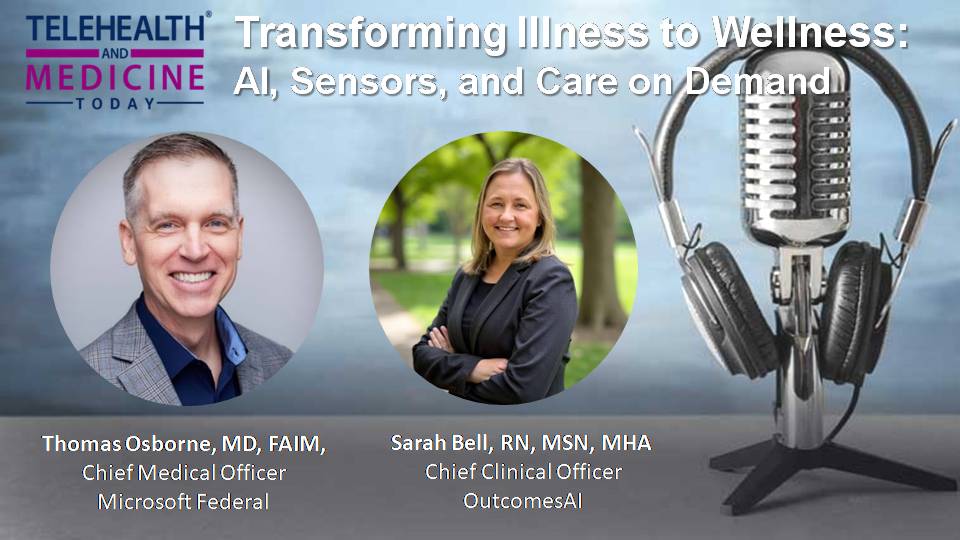
Transforming Illness to Wellness: AI, Sensors, and Care on Demand
DOI:
https://doi.org/10.30953/thmt.v11.768Keywords:
artificial intelligence, care on demand, connected care, digital health, remote patient monitoring, sensors, wearable devicesAbstract
Healthcare is generating more continuous, real-time data than ever through sensors, wearable devices, remote patient monitoring and connected care platforms. The opportunity is significant, but collecting data alone does not improve outcomes. Information must be translated into timely, clinically meaningful action without adding to clinician workload or fragmenting the patient experience.
In this podcast, Thomas Osborne, MD, Chief Medical Officer of Microsoft Federal, and Sarah Bell, RN, Chief Clinical Officer of OutcomesAI, examine how artificial intelligence, sensors, virtual care and remote monitoring can converge into a more responsive care model—one that identifies needs earlier, connects patients to appropriate care more quickly and supports the transition from treating illness to maintaining wellness. Discussion Questions include:
Sensors and AI: What Is Real Today?
- Where are sensors and AI creating real clinical value today?
- Which applications are changing how care is currently delivered?
Making Continuous Data Clinically Useful
- How can continuous health data become actionable without overwhelming clinicians?
- What role can AI play in determining who needs attention, when and why?
Telehealth as the Bridge to Care on Demand
- What must change for telehealth to progress beyond traditional appointments and enable genuine care on demand?
- How can virtual care, remote monitoring and AI operate as one coordinated care model rather than separate technologies?
Building a Care-on-Demand Model That Works
- What could care on demand look like five years from now?
- What are the greatest barriers: reimbursement, workflow, interoperability, staffing, trust or something else?
From Reactive Care to Wellness
- How can earlier identification and faster access to care help shift healthcare from treating illness toward maintaining wellness?
- Over the next five years, what will change most about when and where patients receive care?
Downloads
Published
How to Cite
Issue
Section
License
Copyright (c) 2026 Sarah Bell, RN, MSN, MHA, Thomas Osborne, MD, FAIM

This work is licensed under a Creative Commons Attribution-NonCommercial 4.0 International License.
Authors retain copyright of their work, with first publication rights granted to Telehealth and Medicine Today (THMT).
THMT is published under a Creative Commons Attribution-NonCommercial 4.0 International License.